


August 6, 2013
Desperate to Retire? Don’t.
A new article in the Journal of Financial Planning lays out the unpleasant reality facing baby boomers who really want to retire but can’t afford it: working longer helps a lot.
In the article, David Blanchett, who heads the retirement research group for Morningstar’s money management unit in Chicago, calculated the impact of delaying one’s retirement date and found that it can sharply improve a retiree’s odds of financial success.
“There is not one silver bullet for success but if there were it would be delaying retirement,” he said in an interview.
The same case has been made for years by the Center for Retirement Research at Boston College, which supports this blog. Working beyond age 62, when individuals are first eligible to receive Social Security benefits, helps in three important ways: …Learn More

August 1, 2013
Student Debt May Slow Home Buying
First-time buyers are currently responsible for about 29 percent of all U.S. house sales, down from historical levels of 40 percent, according to the National Association of Realtors. The share of young adults who own a house has also declined sharply.
There’s debate about whether buying a house is a good financial move. But the waning of this coming-of-age ritual is a significant change in behavior for young adults in this country.
 One culprit may be student debt, which is becoming more prevalent – 43 percent of young adults have some, compared with 25 percent a decade ago. The average borrower’s balance has also doubled in the past decade, to more than $20,000 in 2012.
Researchers at the Federal Reserve Bank of New York believe these unprecedented student debt levels may be dampening house purchases by first-time buyers. Student loans cause individuals to do poorly under two of the primary tests by Freddie Mac and Fannie Mae that lenders use to approve standard home loans. …Learn More
July 25, 2013
Reverse Mortgages Get No Respect

Fran and Bob Ciaccia
Bob and Fran Ciaccia could not be happier with their reverse mortgage, which unlocked some of the equity in the house they purchased in 1966 for $12,500.
Reverse mortgages are federally insured loans available to U.S. homeowners over age 62. The loan is made against the equity in the house, and the principle, plus interest and some federal insurance fees, are not repaid until the homeowners or their children sell the house.
“I cannot find a downside,” Fran Ciaccia, a retired high school cafeteria cook from Levittown, Pennsylvania, said in an interview. “We have told so many people about it.”
Although the Ciaccias may be big fans, reverse mortgages are unpopular, despite historically low interest rates that make them a good deal for retirees right now. AARP has estimated that only 1 percent of older Americans use them.
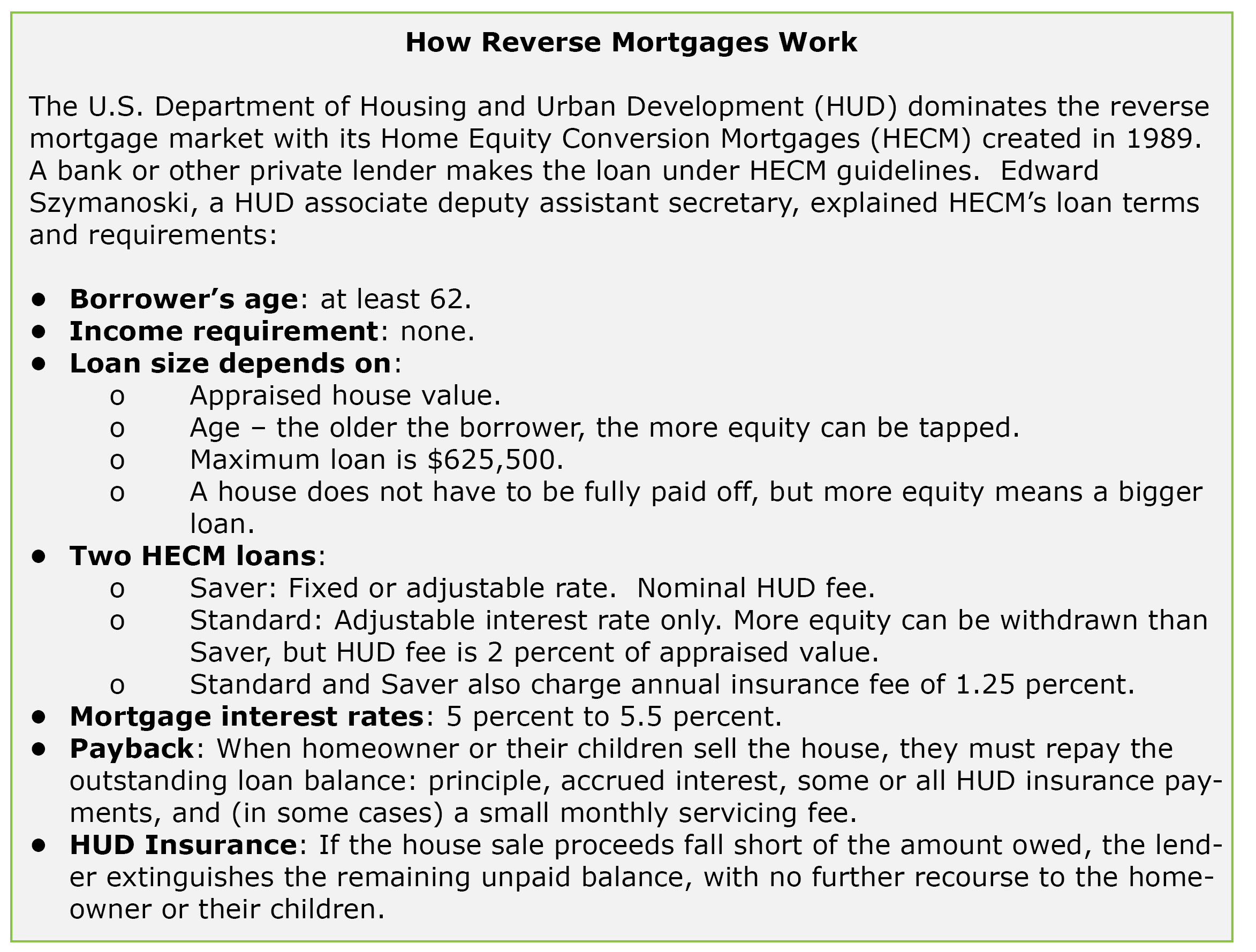 In 2012, the average loan size was $158,228, and 54,676 Americans got one. That is less than half the loans made in the peak year, 2009, according to the U.S. Department of Housing and Urban Development, which insures and sets standards for reverse mortgages. …Learn More

July 23, 2013
The Aging Mind and Money
As we age, the things we forget are at first laughed off as “senior moments.” But when forgetting to send a birthday card becomes forgetting to pay the mortgage, the natural cognitive decline that accompanies aging becomes a serious financial issue.
With Americans living longer and an estimated 10,000 baby boomers turning 65 every day, a spate of fresh research has examined how and whether older brains can handle the challenges of modern financial life. But what the researchers have found out so far about the aging mind and money is somewhat of a mixed bag.
First, the bad news. Diminished cognition is an increasingly important concern in the financial arena, because the choices faced by retirees are getting ever more complex. One recent survey of people either experiencing cognitive decline themselves or observing it in a family member pinpointed the kinds of financial decisions that older people find difficult.
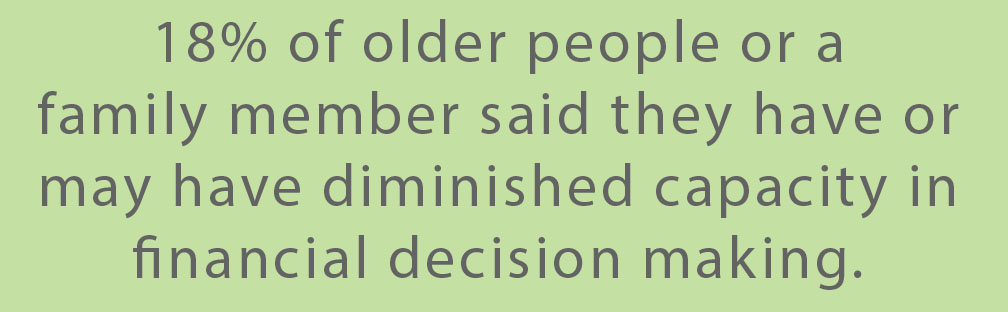 Among those surveyed, 41 percent said they or their family member forgot to pay their bills and 14 percent paid the same bill twice, according to the National Endowment for Financial Education and Harris Interactive. More than one-third had trouble with simple math or made rash purchases.
Retirees today face bigger financial challenges than that if they have to juggle their 401(k) investments and withdrawals. This is a change from the days when an employer simply issued a check every month from the defined-benefit pension plan, said Laura Bos, AARP’s acting vice president of financial education and outreach. …Learn More

June 27, 2013
62YO Men File Social Security; Wives Pay
My father was never more in love with my mother than on the day he died in 2004, days before their 50th anniversary.
But he made one bad financial decision that she lives with today: he started up his Social Security benefits at age 62.
He felt he needed the money sooner than later. He had an inadequate pension from his first career, as an Air Force flyboy, and none from his Rust Belt business that went bust. But waiting to claim his Social Security would’ve increased the size of his check – and, after he died at 70, the money that’s still deposited into my mother’s bank account every month.
This happens to a significant share of couples, because almost 40 percent of all Americans claim their benefits the same year they turn 62. But a husband who waits until age 65 can increase his widowed wife’s future benefits by up to $170 a month, according to new research by Alice Henriques, an economist with the Federal Reserve Board in Washington.
What’s interesting about this study of nearly 14,000 older couples is that she teased out how much the husband’s decision was determined by the filing date’s impact on his own benefits, versus the financial impact on his wife’s spousal and, later, her survivor benefits. Similar research in the past had examined the impact of a filing date on their combined benefits during all their years of retirement.
Henriques was able to show that the husbands, when they made their decisions, took into account the impact on themselves of the claiming date they selected. But they showed virtually “no response to the large incentives” of having the ability to provide their widowed wives with more income in the future, she said. …Learn More
June 20, 2013
Older Patients Tell Doctors, “Charge It!”

New research has uncovered one reason for the alarming rise in credit card use among older Americans: medical bills.
When people age 50 or older experience “health shocks” – newly diagnosed medical conditions – their credit card balances rise, according to research published in the Journal of Consumer Affairs. The worse the medical condition, the more they charge.
A mild, new medical problem, for example, adds $230 to credit card bills – that’s a 6.3 percent increase on a starting balance of $3,654. If the new condition is severe, balances increase by $339, or 9.3 percent.
Separately, the researchers looked at the effect of out-of-pocket medical costs, such as copayments for doctor visits and prescriptions not covered by private insurance or Medicare. For each $100 that those costs increase, about $4.50 winds up on the cards, according to Hyungsoo Kim at the University of Kentucky, WonAh Yoon at the Samsung Life Retirement Research Center in Seoul, Korea, and Karen Zurlo at Rutgers University.
Their findings shed new light on why more older Americans, who have the greatest medical needs, are becoming reliant on credit cards with their high interest rates. …Learn More
June 6, 2013
Nobel Winners Are Unsure Investors

Medal for the Sveriges Riksbank Prize in Economic Sciences. © ® the Nobel Foundation
A Los Angeles Times reporter once called up several Nobel laureates in economics to ask how they invest their retirement savings.
One of the economists was Daniel Kahneman, a 2002 Nobel Prize winner who would become more famous after writing “Thinking, Fast and Slow” about the difference between fast, intuitive decision-making and slow, deliberative thinking. Kahneman admitted to the reporter that he does not think fast or slow about his retirement savings – he just doesn’t think about it.
Kahneman’s confession in the 2005 article seems even more relevant in today’s 401(k) world. Americans are realizing the investment decisions imposed on them by their employers may be too complex for mere mortals. For example, three out of four U.S. workers in a 2011 Prudential survey said they find 401(k) investing confusing.
Readers might take comfort in learning that even some of the world’s great mathematical minds have admitted to wrestling with the same issues they do: How do I invest my 401(k)? Should I take some risk? How about international stocks?
Here are the Nobel laureates remarks, excerpted from the article, “Experts Are at a Loss on Investing,” by Peter Gosselin, formerly of The Los Angeles Times:
Harry M. Markowitz, 1990 Nobel Prize:
Harry M. Markowitz won the Nobel Prize in economics as the father of “modern portfolio theory,” the idea that people shouldn’t put all of their eggs in one basket, but should diversify their investments.
However, when it came to his own retirement investments, Markowitz practiced only a rudimentary version of what he preached. He split most of his money down the middle, put half in a stock fund and the other half in a conservative, low-interest investment. …Learn More
About Squared Away

Learn more about our blog and its writer, Kimberly Blanton, a former Boston Globe reporter.
