


April 9, 2013
Unemployed Boomers Resist Retirement
Brisk sales of Linda Novak’s crocheted scarves and baby blankets have subsidized the 62-year-old’s Manhattan rent since her 2012 layoff. Boston resident Marcus Queen, 58, receives food stamps while trying to reignite his beloved career: helping city kids get a leg up. Joseph Imperiale, 66, wants to get back into the business world, so he doesn’t have to tap his retirement savings yet.
Nearly three years after the Great Recession officially ended, more than 900,000 baby boomers laid off several months or years ago are still pounding the pavement, unable to find employment in an economy that produced only 88,000 jobs in March. They simply are not ready to retire – financially or emotionally – but they often feel that unemployment is forcing them to do so prematurely.
It takes boomers longer to find employment than it does younger job seekers, creating financial challenges unique to their stage of life. They could begin collecting their Social Security benefits immediately upon becoming eligible, at age 62, but the largely irreversible decision to accept a reduced monthly check would haunt them throughout retirement. They can’t afford to put more money into their savings – in fact, if things get really rough, they may have to raid the 401(k) to pay the bills.
UJA-Federation of New York, a Jewish social services agency, is increasingly seeing older workers “who lost their jobs a while ago and have depleted all their assets, and they realize they’re really in trouble,” said Elisabeth Kostin, the planning manager for the agency’s programs for the unemployed. She added, “If someone becomes unemployed as they’re approaching retirement, their value and worth is also depleted.”
Novak, Queen and Imperiale agreed to share their stories about how they try to keep their spirits up and the doors open. …Learn More

February 26, 2013
Millennials in Debt: Is It a Big Deal?
Young adults, when asked if they have college loans, often just sigh or groan quietly.
But how much does this debt really matter to their lives? Conflicting trends make this difficult to answer. College graduates have ample time – decades of employment – to pay off their student loans, economists argue, and they’ll bring in more earnings to pay them back. A college education is worth $1 million in extra earnings over a lifetime.
Behind the student-loan sigh is anxiety that the post-Great Recession job market makes it tougher for many graduates to earn what they need to pay their loans back. Indeed, the rate of delinquencies has risen in tandem with increased borrowing. Payments on half of all student loan accounts are now being deferred, the consumer credit firm TransUnion reported last week, and these deferrals are the first step to still more delinquencies.
Some researchers are warning about the additional financial risks facing graduates with large loan balances. “That didn’t happen in previous generations,” said Ohio State University’s Lucia Dunn, whose study published last month in Economic Inquiry found that young adults are on a path to having far more credit card debt in middle age than did their baby boomer parents. Credit cards, student loans – debt of all kinds – she said, “is just an overwhelming burden for many young people.” …
Learn More

February 14, 2013
Women in Debt Less Likely to Marry
Women with large student loan balances are less likely to marry than their girlfriends who’ve graduated debt-free, new research shows.
Men, in contrast, are immune to this impact. Their marriage prospects are the same regardless of how much they owe for their education, according to Fenaba Addo, who studied the effect of college and credit card debt in the “marriage market.”
As U.S. college debt outstanding has surpassed the $1 trillion mark, the fallout is widening. Recent graduates complain that paying off their student loans affects their ability to take critical steps to improve their future finances, such as buying a house or saving for retirement. But there are psychological effects too: young adults who carry a lot of debt, for example, are more stressed, even depressed.
It was only a matter of time before student loans started messing with their love lives.
Addo, now a post-doctoral fellow at the University of Wisconsin’s Department of Population Health Sciences, became interested in the topic as she watched her girlfriends taking on “crazy amounts of debt” to finish college or complete graduate degrees… Learn More
November 8, 2012
Women’s Pay Gap Explained
Lower pay for women came up – where else! – in the foreign policy debate between President Obama and Governor Romney. It affects women’s living standards, single mothers’ ability to care for their children, and everyone’s retirement – husbands and wives.
To understand why women earn 77 cents for every dollar earned by men, Squared Away interviewed Francine Blau of Cornell University, one of the nation’s top authorities on the matter. A new collection of her academic work, “Gender, Inequality, and Wages,” was published in September.
Q: How has the pay gap changed over the years?
Blau: For a very long time, the gender-pay ratio, which is women’s pay divided by men’s pay, was around 60 percent – in the 1950s, 1960s and 1970s. Around the 1980s, female wages started to rise relative to male wages. In 1990, the ratio was 72 percent – that was quite a change, from 60 to 72 in 10 years. We continued to progress but it is less dramatic. In 2000, it was 73 percent. Now it’s 77 percent – that’s the figure that came up in the debate.
Q: Why do women earn less?
Blau: There are two broad sets of factors: the first is human capital and the factors that contribute to productivity and the second is discrimination in the labor market. Women have traditionally been less well qualified than men. The biggest reason here is the experience gap between men and women. Traditionally, women moved in and out of the labor force, and that lowered their wages relative to men.
But when we do elaborate studies – my recent study with Lawrence Kahn in 2006, for example – we find that when we take all those productivity factors into account we can’t fully explain the pay gap. The unexplained portion is fairly substantial and is possibly due to discrimination, though it could be various types of unmeasured factors. So in the 1998 data used in our 2006 article, women were making 20 percent less than men per hour. When we take human capital into account, that figure falls to 19 percent. When we add controls for occupation and industry – men and women tend to be in different occupations and industries – we can get a pay gap of 9 percent. This unexplained gap of 9 percent is potentially due to discrimination in the workplace. …Learn More
November 6, 2012
Dicey Retirement: The Long Ride Down
No one really needs confirmation of how tough the Great Recession was. But the Center for Retirement Research at Boston College has quantified the decline – and it’s brutal.
Investment losses and falling home prices placed 53 percent of U.S. households in danger of a decline in their standard of living after they quit working and retire, reports the Center, which funds this blog. That’s up sharply from 45 percent in 2004, prior to the financial boom, which created a strong – albeit fleeting – increase in Americans’ wealth.
The longer-term erosion in Americans’ retirement prospects is even more troubling and reflects deeper issues. The Great Recession just hammered the point home.
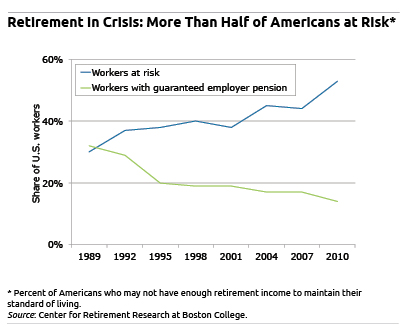 In 1989, just under one-third of Americans faced such dicey retirement prospects. The steady erosion since then coincides with the near-extinction of traditional employer pensions that guaranteed retirees a fixed level of income. It turns out that the DIY system that replaced them, a system reliant on Americans’ ability to save in their 401(k)s, is not working.
Older baby boomer households with 401(k)s have just $120,000 saved for retirement, according to the Center. That’s not even enough to pay estimated medical costs not covered by Medicare. Retirement savings for all older boomer households is a paltry $42,000 – that means a lot of people have no savings…Learn More
October 16, 2012
20-Somethings Buck Pressure to Spend
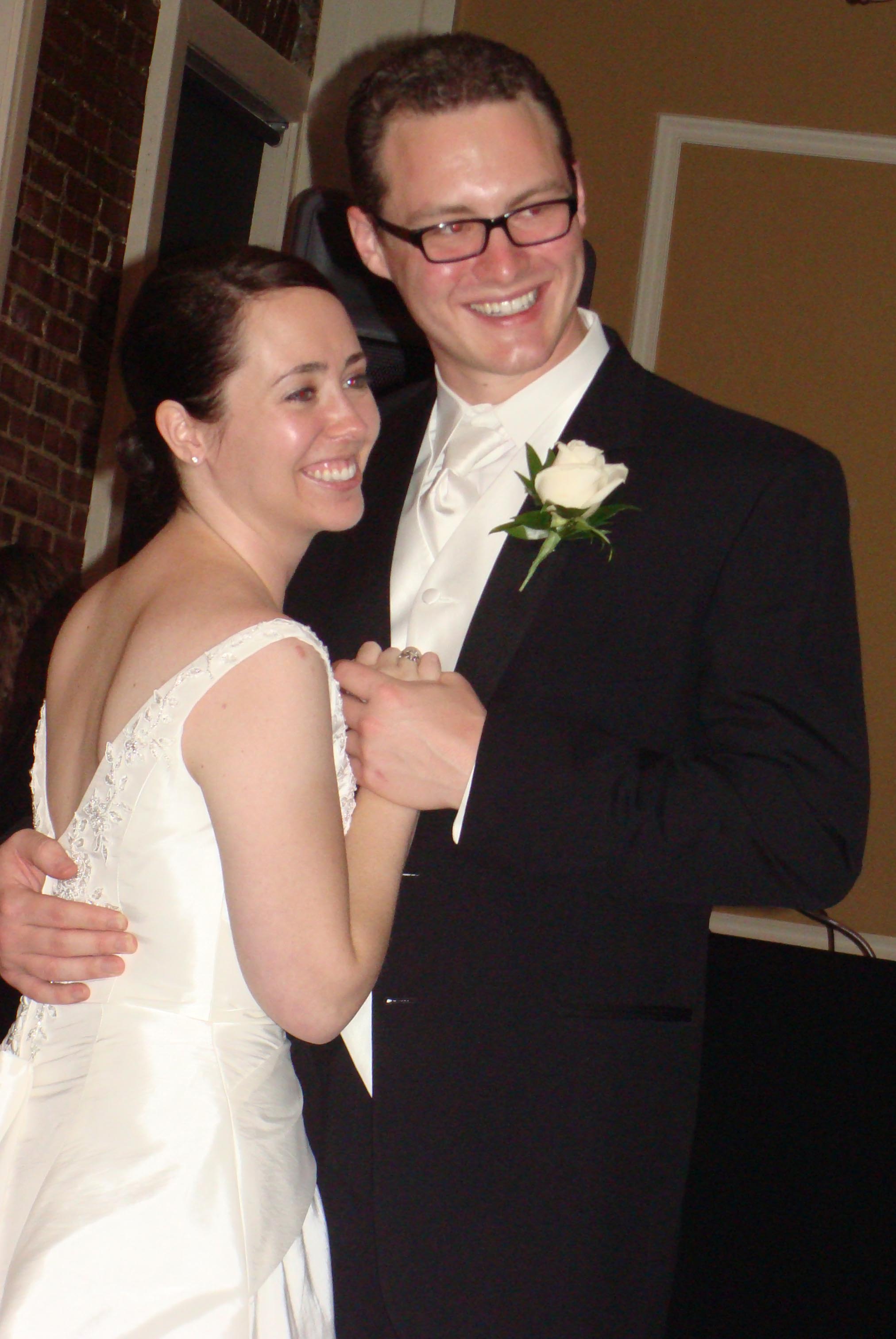
Newlyweds Erin and Michael Gallagher
Michael and Erin Gallagher are just 26 years old but have made a strong start financially, socking away $50,000 by maxing out their 401(k)s while honoring a $20,000 budget for their October 5 wedding in downstate Illinois.
Jennifer and John Lucido, both 32 years old, now have $250,000 in the bank and have built a 2,500-square-foot home near Detroit.
By comparison, the typical U.S. household had saved $42,000 for retirement in 2010, according to the Center for Retirement Research, which funds this blog.
Both couples are members of that rare species of 20-something super savers, spurning intense peer pressure to spend money on consumer items, go out for dinner a lot, and run up their credit cards. Neither couple got where they did the easy way either. They worked hard, but they were also quick to catch on to important lessons about being frugal and saving – from their parents or from each other.
“I have clients in their 30s and 40s who don’t even have $200,000 in their 401k,” said Naomi Myhaver, a financial planner at Baystate Financial Services in Worcester, Massachusetts.
An August article in The Journal of Consumer Affairs suggests one reason people like them are so hard to find. Young adults are extremely vulnerable to peer pressure to run up credit card debt so they can support a high lifestyle and social life.
In the study, 225 college students were asked questions such as whether they have “very strong” connections to their friends or “feel the need to spend as much as [friends] do on activities we do together.” College students have an average of 4.6 credit cards and $4,100 in debt…
Learn More

September 6, 2012
Campaign Discourse Misses Major Issue
Retirement-income security is receiving little attention as the presidential campaign heats up, despite a mound of evidence that Americans’ retirement prospects are stagnating – or worse.
While Medicare has been at the center of the debate, there has been little emphasis on the broader topic of income security for what remains the largest demographic bulge in U.S. history – the baby boomer generation – and now the largest block of retirees.
In the retirement community, however, debate swirls constantly about how bad the situation really is. These debates are slicing the onion awfully thin when one research paper or report after another contains a new aspect of the troubling fallout from the final years of a transition from secure, employer-guaranteed pensions to DIY retirement. Sometimes it seems that Wall Street’s collapse in 2008 was just the kickoff for the bad news on the retirement front.
A new report from Boston College’s Center for Retirement Research, which funds this blog, finds that just 42 percent of workers in the private sector had pension coverage in their current jobs in 2010 – that’s coverage of any kind, including the defined-contribution plans that now dominate. Yikes!…Learn More
About Squared Away

Learn more about our blog and its writer, Kimberly Blanton, a former Boston Globe reporter.
