

November 14, 2019
More Retirees Today Have a Mortgage
In one significant way, retirement is materially different than it used to be: far more retirees are still trying to pay off their houses.
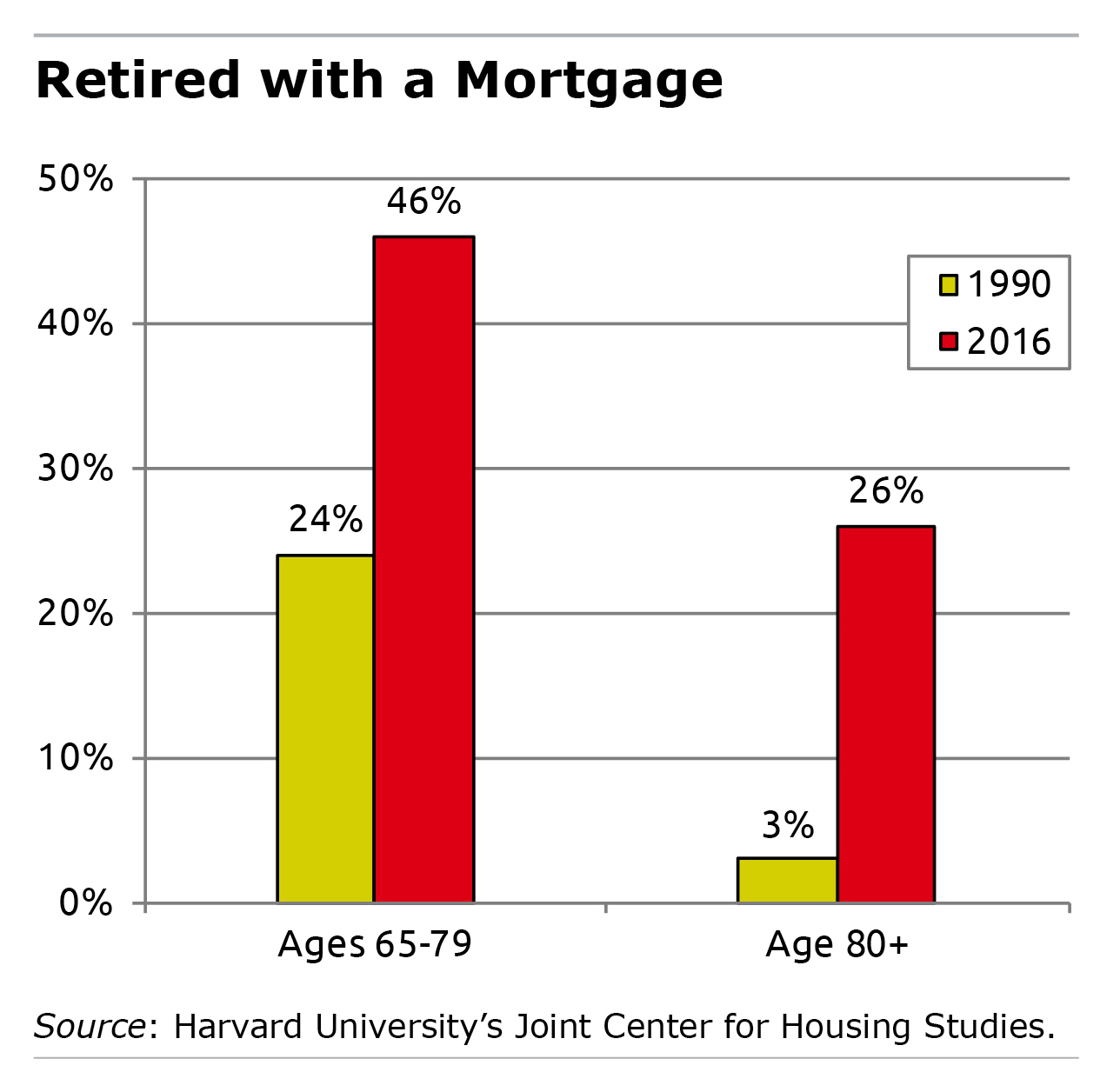 Thirty years ago, just one of every four homeowners in their late 60s to late 70s still had a mortgage – today, nearly half do. Once people hit 80, mortgages used to be extremely rare – only 3 percent had them. Today, it’s one in four, Harvard’s Joint Center for Housing Studies recently reported.
Retiree’s financial condition depends on much more than how much they spend on housing – in particular the size of their retirement savings accounts and Social Security checks. But rent or a mortgage payment is typically the largest item in the monthly budget. Being free of both can be a significant boost to one’s standard of living in retirement.
Jennifer Molinsky, a senior research associate at Harvard’s housing center, described several developments over the past three decades that may explain the dramatic increase in the share of retirees with mortgages.
First, she said, Americans today “seem to have less aversion to debt” than the generation that grew up after the Great Depression and was instilled with frugality. Although consumer debt levels always ebb and flow with the economy’s cycles, total debt as a percentage of disposable income is significantly higher today than it was in the 1990s. The 1986 tax reform act also made mortgages a more attractive form of debt to hold. The reform eliminated the income tax deductions for interest on credit cards and other types of consumer debt, with one exception: mortgage interest.
Having a mortgage isn’t necessarily a bad thing. Mortgage rates have fallen dramatically in recent decades. Many retirees who are still making monthly mortgage payments were able to reduce the payments by refinancing old, partially paid off mortgages into new 30-year loans with lower interest rates.
But another factor that may have pushed up the share of retirees with mortgages has been the long-term run-up in house prices, relative to earnings, which makes it increasingly difficult to pay off a house before retiring. In the late 1980s and early 1990s, house prices were about three times the typical household’s earnings, according to the housing center. Today, prices are more than four times earnings. …Learn More

October 31, 2019
Boomers at 80: Housing Issues to Grow
The baby boom generation is continuing to work its way up the age ladder. The number of Americans over 80 will more than double to nearly 18 million over the next two decades.
And that’s partly because baby boomers are healthier and are living longer – they are also enjoying more of their retirement years free of disability than previous generations. But unfortunately, boomers can’t avoid the inevitability of their growing vulnerabilities and the impact this will have on their day-to-day lives. A new report by Harvard’s Joint Center for Housing Studies makes some sobering predictions about the issues the oldest retirees can expect to face in the future, from widening income inequality to more people living alone and in isolation.
The findings, taken together, point to a range of potential trouble spots revolving around housing our aging population.
- As people get old, their spouses die, their bank accounts dwindle, and their rents keep rising. For these and other reasons, housing creates more of a cost burden at 80 than at 65. The Harvard housing center defines someone as cost-burdened if they spend more than 30 percent of their income on housing. Today, nearly 60 percent of households over 80 fit this definition, and their absolute numbers will increase as more baby boomers reach that age. One place the financial strain shows up is food budgets: retirees who spend disproportionate amounts on housing spend half as much on food as people whose housing costs are under control. …

October 29, 2019
People Tap IRAs After the Penalty Ends
Workers are apparently very eager to get their hands on the money in their retirement savings plans.
The evidence is the spike in withdrawals from IRA accounts that occurs soon after people turn 59½, the age at which the IRS’ 10 percent penalty on early withdrawals vanishes and is no longer a deterrent, according to a research study.
Average annual withdrawals from IRA accounts surge by about $1,965 to $3,540 – an 80 percent increase – after people cross the age 59½ threshold, according to the study, which was conducted for NBER’s Retirement Research Center by researchers at Stanford University, the University of Chicago, and the Federal Reserve Bank of Chicago.
Early withdrawals from tax-deferred retirement accounts – IRAs and 401(k)s – usually are not for frivolous reasons. This money tends to be tapped to ease financial hardships, such as unemployment, a disability, or a large, unexpected medical expense. But when older workers withdraw retirement funds – even for important matters – they may be chipping away at their financial security in old age. Withdrawals by high-income workers, on the other hand, will likely have little impact on their security.
The researchers analyzed taxpayer data from the IRS, which requires withdrawals to be reported at tax time. They compared withdrawals by people in the dataset for the two years before they turned 59½ with their withdrawals between 59½ and 60½.
While the penalty was in place, daily withdrawals were largely flat. But soon after people crossed the age 59½ threshold, withdrawals spiked before declining “to a new higher level than that of prior ages,” the researchers found. …Learn More
October 24, 2019
Part D Cost for Brand Name Drugs Rising
Reforms to Medicare Part D under the Affordable Care Act brought significant relief to retirees by reducing the share of medication costs they must pay out of their own pockets.
But with the healthcare reform now nearly a decade old, other developments have taken over that will drive up drug costs for the most vulnerable retirees – the biggest users of expensive brand name drugs. Although only a few million people will be affected, they are already saddled with the highest spending burden.
This vulnerable group could get some help from Congress. There is bipartisan support for placing an absolute limit on how much Part D policyholders must pay in total for their prescriptions, said Juliette Cubanski, associate director of the Medicare policy program at the Kaiser Family Foundation.
“That’s a positive development,” she said, “but there are also several areas of disagreement in the legislation being considered on the House and Senate sides.”
Under the Affordable Care Act (ACA), retirees are required to pay 25 percent of their total drug costs up to the annual threshold that qualifies them for catastrophic coverage – this dollar threshold is the total of their own payments plus the price discounts from manufacturers of brand name drugs. The upshot in 2020 for retirees is that those with the highest need could spend about $375 more out of their own pockets before they enter Part D’s less-onerous catastrophic coverage phase, according to a Kaiser analysis. And that’s just the increase for next year – their outlays will rise over the next decade. 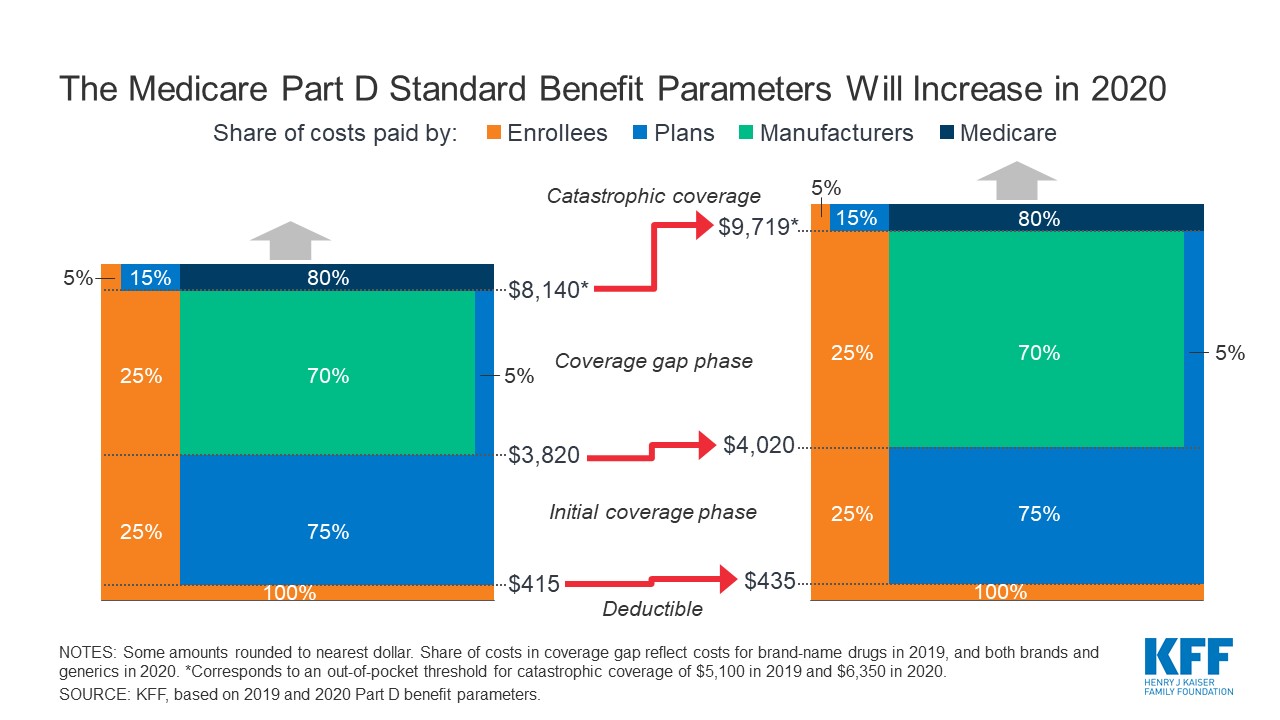
Once retirees enter the catastrophic phase, they are protected, because Medicare begins picking up the vast majority of the tab. But out-of-pocket costs are rising because the ACA’s controls on the spending threshold they must cross to qualify for catastrophic coverage have ended. …Learn More

October 22, 2019
Most Data Sets Agree on Retiree Income
What kind of financial shape are retirees in?
A 2017 study refocused attention on this old question, and it has taken on greater urgency as more and more baby boomers retire.
The study looked at the accuracy of the U.S. Census Bureau’s Current Population Survey (CPS) and confirmed earlier research showing that it dramatically under-estimates retirees’ income. The under-reporting in the CPS could raise concerns about the accuracy of other surveys that paint a less-than-rosy picture of retirement life.
To get to the bottom of things, the Center for Retirement Research (CRR) dug into other standard sources of survey data on retired households so they could be compared with CPS data. They found that the income estimates in the CPS were much lower than the others and clearly the outlier – the other four data sets roughly agreed on how much income retirees have.
The CRR researchers then selected one of the reliable sources of income data – the Health and Retirement Study (HRS) – to assess how retirees are faring. They concluded that around half of over-65 households may be experiencing difficulty maintaining the standard of living they enjoyed while they were working. The researchers based this on the rule of thumb that they need about 75 percent of their past employment earnings.
To be sure, every survey has its strengths and shortcomings, because they rely on what people say they are getting from their Social Security, retirement plans, and investments. …Learn More

October 8, 2019
Medicaid is Crucial to Rural Hospitals
Rural hospital closings can be a matter of life or death.
Residents in these remote locations may have to drive 100 miles or more for emergency medical care. One new study found that hospital closings increase mortality in rural areas by 6 percent. No such impact occurred in urban areas with multiple medical centers.
Both urban and rural hospitals serving poor and low-income patients face myriad financial pressures, led by Medicare and Medicaid’s relatively low reimbursement rates for their disproportionate numbers of older and sicker patients. The 2013 federal budget, which cut Medicare reimbursements for hospitals and physicians by 2 percent, compounded the problems.
But what has become increasingly clear in rural areas is that the option given to states under the Affordable Care Act (ACA) to expand their Medicaid-covered populations of high-need patients has created a dividing line between the most vulnerable hospitals and the survivors, said Brock Slabach, senior vice president of the National Rural Health Association, a hospital trade group.
With closures accelerating across the country over the past decade, 24 of the 31 rural hospitals that closed in 2018 and 2019 were located in the minority of states (14) that have not expanded their Medicaid programs, according to the Sheps Center for Health Services Research at the University of North Carolina, which tracks hospital closures.
In contrast, the ACA has bolstered rural hospitals in expansion states by cutting their uninsured populations roughly in half by bringing in a fresh supply of federal and state revenues to insure more patients under Medicaid. …Learn More
September 19, 2019
Many Demands on Middle Class Paychecks
Ask middle-class Americans how they’re doing, and you’ll often get the same answer: there are still too many demands on my paycheck.
Several recent surveys reach this conclusion, even though wages have been rising consistently at a time of low inflation.
Student loans trump 401(k)s. Two top financial priorities are in conflict: student loan payments, which people described as a “burden,” and saving for retirement, which they viewed as “important” in a TIAA-MIT AgeLab survey.
The debt seems to be winning: three out of four adults paying off student loans say they would like to increase how much they save for retirement but can’t do it until their loans are paid off – and that can take years. One woman described her loans as “draining” her finances.
A promising sign on the horizon is that some employers are finding creative ways to help employees pay down college debt, giving them more leeway to save money in their 401(k)s. But these efforts impact a small number of workers, and the amount of debt continues to rise year after year for every age group, from new graduates to baby boomers who helped send their children and grandchildren to college, a Prudential study found.
 Buying a house isn’t an option. The good news is that about half of Millennials already own a home. Most of the others want to buy a house but can’t afford it, 20- and 30-somethings told LendEdu in a survey. Their top reasons were student loan and credit card payments and a lack of savings, which is the flip side of having too much debt.
Millennials are also putting off other goals until they get a house – marriage, children, even pets. “It’s quite obvious that this uphill battle” and debt “is having secondary effects,” said LendEdu’s Michael Brown.
Medical debt looms large. Americans borrowed $88 billion last year to pay their hospital, doctor, and lab bills. That debt fell hardest on the 3 million people who owe more than $10,000, according to an estimate by the Gallup polling company and a group of healthcare non-profits. …Learn More
About Squared Away

Learn more about our blog and its writer, Kimberly Blanton, a former Boston Globe reporter.
