


March 7, 2013
Future Retirees Don’t Grasp Health Costs
More than half of baby boomers and Generation Xers do not realize how much they are likely to pay out of their own pockets for medical bills after they retire.
Many “were seriously underestimating the amount of savings they would need to accumulate in order to cover health in retirement,” according to what may be the first comprehensive survey and analysis of what Americans expect to pay – and how far off their estimates are.
The good news is that Medicare pays roughly 60 percent of retirees’ total costs. The bad news is that they have to somehow cover the other 40 percent, which is particularly expensive for those who live longer (read women).
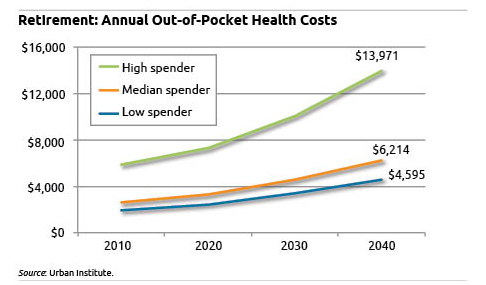
If this new study carries one big message, it is that boomers need to learn more about what will certainly be one of their biggest retirement expenses. For example, by 2020, the range of out-of-pocket spending is expected to vary from $2,453 per year for a typical person with low health care needs to $7,272 for the typical high spender. Boomers also may not be aware that the bite that Medicare premiums take out of their monthly Social Security checks will increase sharply by 2020.
The new analysis of the disparity between future retirees’ expectations and what they’re facing was conducted by law professors Allison Hoffman at the UCLA School of Law and Howell Jackson at the Harvard Law School. …Learn More
March 5, 2013
Video: Pension Problems Can Be Fixed
The Ontario Teachers’ Pension Plan has produced a terrific video that spells out how pension systems got into the trouble they’re in and proposes the outlines of what’s required to repair them.
The strength of this video is its broad sweep and perspective. It is worth watching for anyone interested in their children’s and grandchildren’s future financial security – as well as their own.
“Pension Plan Evolution” explains that U.S., Canadian, and other western retirement systems were built on the faulty assumptions that the future would keep producing enough younger workers to support retirees, 8 percent annual returns on investments, and economic growth that matched what the baby boom generation enjoyed in its prime.
Watch the entire video below. But if you only have time for the 1.5-minute trailer, click here.
To fix these systems’ finances will require shared sacrifices, the video concludes. The young should not pay for all of the mistakes of earlier generations who have resisted reforms to current pension systems – in other words, fairness matters. Solutions also require creativity in the design of systems that are able to adapt to future changes in the economy or circumstances.

February 28, 2013
The IRA Tax Deduction Beckons
At tax time, many Americans think, often fleetingly, about spending less and socking away more for retirement.
Until April 15, the IRS permits people who do not have a pension plan at work to deduct up to $6,000 for money placed in an IRA; taxpayers who do have an employer pension can also receive the IRA deduction if their earnings fall under the IRS’ income limits.
The tough question that trips people up is: How much will I need?
The easy way to think about this is in terms of the income necessary to maintain your current standard of living after the paychecks stop coming in. Click here for a tool that estimates both how much you’ll need and how much you’ll have if you continue on your current path.
The calculator, created by the Center for Retirement Research, which supports this blog, was designed for people over 50 and on the retirement runway. Younger people can also get a ballpark idea of how they’re doing using the calculator. Or click here for the percent of your wages to put into a tax-deferred retirement fund.
This is a beta website with a few kinks, and it works smoothly only on the Safari and Google Chrome browsers. But the results are sound and backed by academic research. Here’s how to read the results. …Learn More

February 26, 2013
Millennials in Debt: Is It a Big Deal?
Young adults, when asked if they have college loans, often just sigh or groan quietly.
But how much does this debt really matter to their lives? Conflicting trends make this difficult to answer. College graduates have ample time – decades of employment – to pay off their student loans, economists argue, and they’ll bring in more earnings to pay them back. A college education is worth $1 million in extra earnings over a lifetime.
Behind the student-loan sigh is anxiety that the post-Great Recession job market makes it tougher for many graduates to earn what they need to pay their loans back. Indeed, the rate of delinquencies has risen in tandem with increased borrowing. Payments on half of all student loan accounts are now being deferred, the consumer credit firm TransUnion reported last week, and these deferrals are the first step to still more delinquencies.
Some researchers are warning about the additional financial risks facing graduates with large loan balances. “That didn’t happen in previous generations,” said Ohio State University’s Lucia Dunn, whose study published last month in Economic Inquiry found that young adults are on a path to having far more credit card debt in middle age than did their baby boomer parents. Credit cards, student loans – debt of all kinds – she said, “is just an overwhelming burden for many young people.” …
Learn More

February 21, 2013
Corporate Match Falls in Auto Enrollment
Enrollment in 401(k)s is higher in companies that use auto-enrollment than in companies that don’t. But the innovation falls short of an ideal solution to the nation’s low retirement savings.
That’s because corporations using it contribute less of their workers’ earnings to the plan than do companies without it, according to a revised paper by Urban Institute researchers Barbara Butrica and Nadia Karamcheva.
“Firms are profit-maximizers, so we’d expect that, if there is some cost to providing these benefits, they may reduce their match rates to control their costs,” Butrica said.
The researchers found that employers that automatically enroll employees in their plans match their employee contributions up to 3.2 percent of earnings, which is lower than the 3.5 percent average match by employers in their study without auto enrollment. Their statistical analysis shows that it has a significant effect.
Americans are saving very little for their retirement, and news and reports often focus on what individual employees are or are not doing right. Why don’t they save enough? Do they properly invest their 401(k) savings?
This research adds a different perspective: the conflict corporations face between providing better benefits to employees – so they can recruit and retain talent – and maximizing profits to satisfy Wall Street or investors seeking higher profits.
Corporate motivations and decisions can “substantially affect future retirement security,” the authors wrote in an executive summary of their paper funded by the Retirement Research Consortium, which supports this blog. …Learn More
February 19, 2013
Boomers Still Cautious About Stocks
Mutual fund investors poured some $17 billion into domestic equity funds in January, reversing 2012’s trend, according to the Investment Company Institute (ICI), an industry trade group.
But it’s too early to declare that fund investors have fully recovered from the 2008 market collapse, even as the bullish S&P500 stock market index flirts with its 1,565 all-time high reached on October 9, 2007.
Fund investors surveyed by ICI still remain less willing than they were prior to the big bust to take what the survey questionnaire calls “above-average or substantial risks” in their investments.
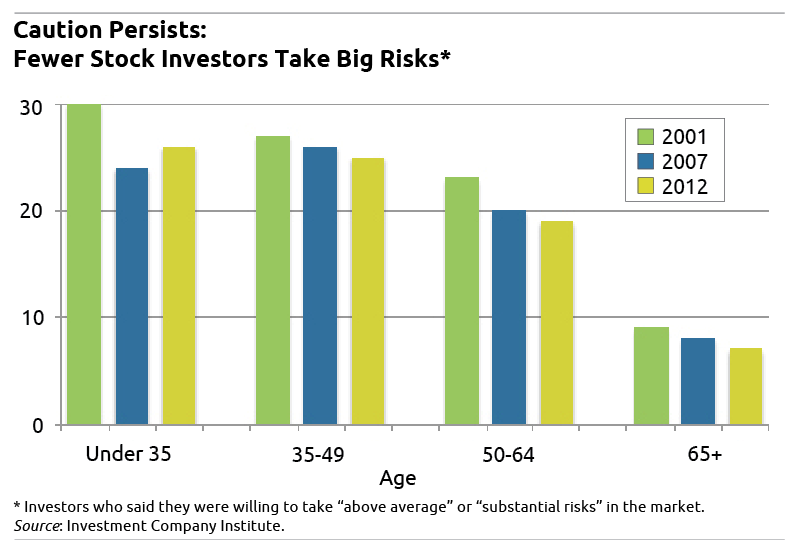 This trend cuts across most age groups, from 40-somethings to retirees. The exception is the under-35 crowd: 26 percent identified themselves as being in these higher-risk categories, slightly more than the 24 percent who did back in 2007.
But boomers nearing retirement and current retirees burned in the 2008 market collapse keep paring back their risk profiles. Older investors are moving “from capital appreciation to capital preservation,” said Shelly Antoniewicz, an ICI senior economist. Even 35-49 year olds, who still have two to three decades of investing ahead of them, are not quite back to where they were earlier in the decade when they were more willing to take risks in the stock market.
“What we have seen historically is that there is a relationship between stock market performance and inflows into equity funds. When the stock market goes up, we tend to get larger inflows into equity funds,” she said. “What we’ve noticed in the past two to four years is this historical relationship has gotten weaker.” …Learn More

February 14, 2013
Women in Debt Less Likely to Marry
Women with large student loan balances are less likely to marry than their girlfriends who’ve graduated debt-free, new research shows.
Men, in contrast, are immune to this impact. Their marriage prospects are the same regardless of how much they owe for their education, according to Fenaba Addo, who studied the effect of college and credit card debt in the “marriage market.”
As U.S. college debt outstanding has surpassed the $1 trillion mark, the fallout is widening. Recent graduates complain that paying off their student loans affects their ability to take critical steps to improve their future finances, such as buying a house or saving for retirement. But there are psychological effects too: young adults who carry a lot of debt, for example, are more stressed, even depressed.
It was only a matter of time before student loans started messing with their love lives.
Addo, now a post-doctoral fellow at the University of Wisconsin’s Department of Population Health Sciences, became interested in the topic as she watched her girlfriends taking on “crazy amounts of debt” to finish college or complete graduate degrees… Learn More
About Squared Away

Learn more about our blog and its writer, Kimberly Blanton, a former Boston Globe reporter.
