


December 6, 2011
United States of Credit
The holidays have arrived, and our credit cards are getting a workout. Sheldon Garon, author of “Beyond Our Means: Why America Spends While the World Saves” (November 2011), maintains that gift shopping isn’t only about giving – it’s our civic duty, we’re told.
Squared Away interviewed the Princeton University historian about world savings rates and America’s “democratization of credit.”
Q: Americans have tightened their belts. How does our current 4 percent savings rate compare with the rest of the world?
 Garon: The Chinese save at extraordinary rates, about 26%. But that’s something that happens with Asian economies just as they’re taking off. The Japanese and Korean economies did that too. The really interesting place is continental Europe. . . . The United States should be going down in its savings rates, because we’re an aging society. But the Europeans should be going down even farther, because they have more rapidly aging societies and very low birth rates. But the German, French, Austrian and Belgian savings rates are around 10 percent – Sweden has gone up to 13%.
Q: How did debt become culturally acceptable here?
Garon: Before the 1920s, it was no honor to be indebted. When installment buying became popular in the 1920s, that was seen as an acceptable form of debt. But we reached a new stage in the early 1990s, when society considered you stupid if you didn’t take on more debt. Why would you save up for something if you could borrow so easily?
What do you think of Garon’s take on U.S. financial culture? Squared Away would like to hear your comments after you read the full interview. …Learn More

December 1, 2011
Card Minimums Cause Puzzling Behavior
What is it about the minimum payment on credit card statements that makes people act so crazy?
Two years ago, Neil Stewart, a psychologist at the University of Warwick in the United Kingdom, confirmed his own and some behavioral economists’ suspicions: when the minimum payment line was entirely deleted from statements, cardholders paid 70 percent more.
The holiday shopping season is in full swing, underscoring how important this initial finding was. Credit-card companies set their minimum payments extremely low, significantly increasing customers’ total payouts over the long term – paying the minimum causes interest costs to accumulate faster.
Stewart and his colleagues have now advanced his prior research by testing how card-carrying Americans and British would react to different levels of minimum payments. The result this time: the higher the minimum, the less people paid.
“We’re not entirely sure what’s going on in people’s heads,” said co-author Linda Salisbury, a professor in the Carroll School of Management at Boston College. The key, however, is a well-known psychological concept called “anchoring,” she said. …Learn More

November 29, 2011
401(k)s: Reaching Young Employees
Nearly one in three employees under age 35 has not enrolled in their 401(k) retirement plan, according to almost half of the major corporations surveyed recently by Northern Trust.
It’s “imperative” that young employees save more than they do, said Lee Freitag, senior product manager for defined contribution solutions at Northern Trust, which surveyed Altria Group, Microsoft, Walgreen and other U.S. companies.
Today’s young workers will rely more on 401(k) savings than any previous generation, he said, now that employer-funded pension plans are virtually extinct in corporate America. Yet many are sacrificing their prime savings years. To retire at age 70, for example, a 25-year-old must save only 7 percent of his or her income, earning investment income over 40 years. This compared with a steep 18 percent of income for someone who waits until age 45 to start saving and has fewer years to accrue investment returns.
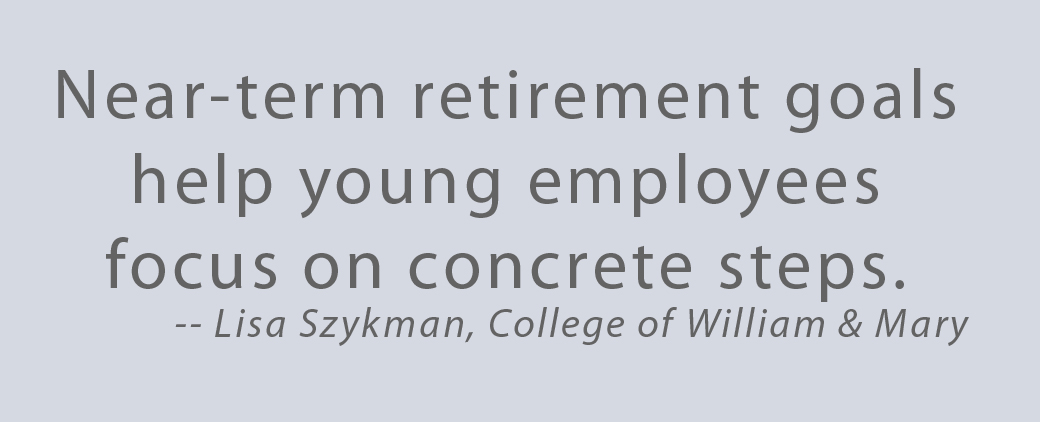 So, how to reach these young adults when it counts? To them, retirement in their 60s is an abstraction – they do not naturally focus on it. According to preliminary research out of the Mason School of Business at the College of William & Mary, how employers communicate may be the key to boosting savings among recent entrants to the workforce, given their long time horizon until retirement.
“We may need to communicate with younger workers differently than older workers,” Nicole Votolato Montgomery, Lisa Szykman, and Julie Agnew write in their new paper.
Their research indicates that employers can help younger employees define the steps they should take – by making them more concrete. This is a different twist on the psychology of saving found in other psychological research – when college students in one experiment saw computer avatars of their older selves, they wanted to save for their old age. …Learn More

November 22, 2011
Game Highlights Tough Choices for Poor
In May, Squared Away’s very first post was about an eye-opening “game” in which players take on the role of someone who is poor. The player is assigned a job and a paycheck. Every financial decision ricochets through the monthly budget, often in unexpected ways. Lives, children, and work choices are affected – poverty even creates unique ethical decisions.
The game, Spent, is so powerful, because its creators interviewed clients of Urban Ministries of Durham in North Carolina, which operates a food pantry, clothing closet, and homeless shelter. A local advertising firm, McKinney, designed the game in conjunction with Urban Ministries.
Happy Thanksgiving.
To play Spent, click here.
To read more, click here.Learn More
November 16, 2011
Readers: Long-Term Care Policies Costly
One intention in introducing Squared Away this year was that it would become a forum for readers to share views about financial behavior, psychology, decision-making, products, education, and culture.
Some articles have been more successful than others in generating readers’ comments in the space provided at the end of each post. A post last week, “Long-Term Care: To Buy or Not to Buy,” was notable for the heat it generated.
It provided reasons the vast majority of the elderly do not purchase long-term care coverage from an insurance company. While the article, based on academic research, was about personal decision-making, readers focused on problems with the policies themselves:
Samantha Price noted:
Firstly, they are very expensive, so no one should be surprised why so many people are not buying. Secondly, many of the more affordable policies are issued by below-quality insurers, who have already shown their unreliability by being unable to pay their policyholders.
VG replied: …
Learn More
November 15, 2011
Student Loans Derail Life Plans
Christi Longlois of New Orleans only slightly exaggerates when she says she and her partner “will be retired before we pay off our student loans.”
Longlois, who works at Tulane University, and Geneva Marney, who works at a non-profit, together owe $80,000 in student loans. Both in their 30s, they have more than 25 years of monthly payments ahead of them.
On their financial planner’s advice, they sold their house and began renting so they could make their $453 monthly loan payments, some of which funded Longlois’ graduate school, and pay their credit cards. They’d like to eventually send their infant twins to private school but don’t feel that’s very realistic.
In interviews with a dozen college seniors and young adults in their 30s, it became painfully clear that loan payments have blasted holes in many life plans – something their baby boomer parents didn’t even worry about. …Learn More

November 10, 2011
Are You Conscientious?
In a recent study of five personality traits, conscientiousness was the strongest determinant of an individual’s financial well-being.
Angela Lee Duckworth at the University of Pennsylvania and David Weir at the University of Michigan compared how people did on a personality test with their financial well-being after age 50. They examined the Big Five traits: conscientiousness, emotional stability, agreeableness, extroversion, and openness to experience.
Their finding about the power of conscientiousness adds to a spate of research combining psychology and economics to predict why people earn more, save more, or prepare for retirement. In another study, Australian researchers found that a child’s level of self-control, as early as age 3, can predict whether he or she will experience financial problems later in life.
So, what is conscientiousness and do you have it? I could tell you about it, but watch the video interview of Duckworth instead, on the University of Michigan Center for Retirement Research’s website.
Hint: is your desk clean?
Full disclosure: The research cited in this post was funded by a grant from the U.S. Social Security Administration (SSA) through the Retirement Research Consortium, which also funds this blog. The opinions and conclusions expressed are solely those of the blog’s author and do not represent the opinions or policy of SSA or any agency of the federal government.
About Squared Away

Learn more about our blog and its writer, Kimberly Blanton, a former Boston Globe reporter.
