

March 3, 2020
Pre-Retirement Debt is Rising Over Time
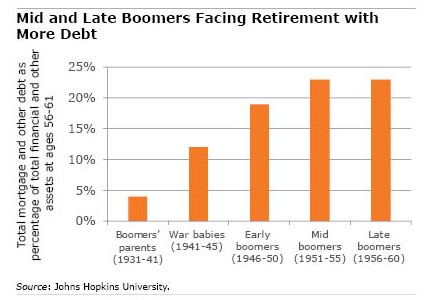 Baby boomers have a lot more debt than their parents did.
By all accounts, the parents were in pretty good shape for retirement because they held their debt levels down to a mere 4 percent of their total assets in the years immediately before retiring – ages 56 to 61 – according to a new study.
At those same ages, the typical baby boomers’ debt has ranged from 19 percent to 23 percent of their assets, thanks in large part to the 2008 drop in stock portfolios and in the housing market.
Generational trends in debt levels are difficult to analyze, and the issue is far from settled among researchers. This study notes, for example, that the situation might not be as grim as the rising debt indicates.
The broad numbers hide the positive step boomers have taken – just as earlier generations did – to reduce their debt as they moved through their 50s. And although the younger boomers have fewer assets than older boomers had at that stage of life, the younger boomers are also working to improve their finances by paying down their mortgages at an accelerated pace.
But the analysis also uncovered another troubling trend for the baby boomers born in the middle of the demographic wave: about 10 percent of them had more debt during their late 50s than their assets were worth. When their parents were that age, some of the most indebted of them still had more assets than debts.
In his study, Jason Fichtner of Johns Hopkins University compared debt-to-asset ratios for five different age groups, starting with the boomers’ parents, who were born during the Great Depression, and running through the people who were born toward the tail end of the baby boom. The chart above is a financial snapshot of rising debt-to-asset ratios for each group when they were between ages 56 and 61. …Learn More

February 27, 2020
Retirement is Liberating – and Hard Work
Most baby boomers find the first weeks of retirement liberating. But it takes some work to ensure the feeling lasts.
“Almost everyone is just thrilled with the first days of retirement, and the big thing is: ‘I do not have to set my alarm,’ ” said Harvard Business School professor Teresa Amabile. Eventually, another thought dawns on a new retiree: “I don’t want to turn into one of those people who sits around in their jammies half the day. I need more of a routine.”
That’s when they start investigating what they’ll do with their time, said Amabile, who, with a team of researchers, interviewed 83 older professionals during their pre- or post-retirement years (or both) to understand the transformation from worker to retiree.
For a smooth transition, the planning should start well before leaving your job, as you process the question of how and when to retire. A critical part of the retirement decision is making sure you can afford it. But the psychological preparation is just as important.
This work, which boils down to four essential tasks, can take several years before and after the retirement date to complete. The first task – the decision to retire – was covered in last Thursday’s blog. Here are the remaining three:
Detach from work. Some people already have one foot in retirement while they’re still working. This can happen organically as an older worker starts to feel marginalized, or it can be a self-directed detachment as he or she becomes psychologically more distant in preparation for leaving. Amabile said completing the process of detaching from work can take weeks or years after retirement day. …Learn More

February 25, 2020
Have You Misplaced a Retirement Plan?
Wouldn’t it be nice to find some money sitting in a long-forgotten retirement account somewhere?
It’s not hard for workers to lose track of an old account as they move from employer to employer, often across state lines. Each state government keeps a repository of unclaimed property – most have been doing this since the 1980s – and residents and former residents can check online through a simple name search in the state’s unclaimed-accounts database.
But not everyone takes the trouble to search for the money or is even aware it exists. So billions of dollars have accumulated nationwide in various types of unclaimed accounts, including retirement plans, insurance policies, trusts, and brokerage and bank accounts – so much so that firms have sprung up that will do the legwork required for individuals to claim their money. But little has been known about how much sits idle in unclaimed retirement accounts.
A new study estimates conservatively that about $38 million, accumulated over many years in some 70,000 retirement savings plans nationwide, had not yet been claimed in the states’ property accounts as of 2016. Most of these are 401(k)-style plans but they also include IRAs and pension checks.
The average account value is only about $550. But the largest ones are anywhere from $5,000 to $13,000, which could be meaningful to retirees who are struggling financially. …Learn More
February 20, 2020
Mapping Out a Fulfilling Retirement
One might say that baby boomers on the cusp of retiring come in two varieties. Some cannot wait to retire and already have a plan. For others, the unknowns fill them with dread.
How will I occupy my days? Should I do something meaningful, or is the goal just to have fun? And how do I figure this out? At 62, this writer really has no idea.
For the other boomers who are feeling this way, take some comfort in knowing you are in good company.
“I can’t say this strongly enough. There are some people who seem to literally not think about what their retirement might look like before they retire,” says Harvard Business School professor Teresa Amabile, whose research team interviewed 83 professionals in their pre- or post-retirement years (or both) to study how they navigate the transition years.
A big part of retiring is letting go of what can be a strong identification with work, and people are reluctant to give that up, she said. This identity might be attached to one’s profession – doctor, professor, carpenter – or to an employer, a specific experiment, or the team on your current project. For others, identity is tied to being the family breadwinner. For many people entering retirement, the basis of that identity is “profoundly shaken,” Amabile said.
Of course, not everyone confronts an identity crisis. Older people who are eager to start a new chapter of their life or are simply burned out by work may find that it’s liberating to shed that old identity and move on.
But, according to Amabile, a more arduous process is common. Many older workers begin to realize, “My identity as a person and my work are really bound up together, so I need to work through that.” A crucial part of planning for retirement is determining “what life is going to be like without work, because work structures your life,” she said.
Amabile described the problems one couple in the study encountered because they didn’t have a solid plan. After retiring, they moved out of the community they’d lived in for 25 years and relocated near some family members. But two years later, they still hadn’t settled comfortably into their new life and “felt at loose ends all the time,” she said.
To prevent this from happening to you, consider that boomers typically must go through four tasks as they transition to a satisfying retirement; Amabile and her team members – Lotte Bailyn, Douglas Hall, Kathy Kram, Marcy Crary, and Jeff Steiner – saw these four tasks in many of their interviews with baby boomers.
The tasks – described below and in a follow-up blog – don’t have to happen in any particular order, though the most common sequence is: Decide to retire. Detach from work. Explore a new life structure. Consolidate a new life structure. …Learn More

February 18, 2020
Electric Bills and Financial Survival
Timing is everything for low-income people who rely on federal benefits to survive.
For example, retirees who receive their Social Security checks early in the month and spend the money before the bills come in are more prone to fill the gap with high-cost payday loans than people who get their checks a few weeks later, a 2018 study found. New research in a similar vein shows that timing also matters for individuals who receive food aid under the federal Supplemental Nutrition Assistance Program, or SNAP.
 When the electricity bill arrives on or within a day of the monthly SNAP benefit, the lowest-income customers in this study were much less likely to have a past due bill or to have their power cut off than customers whose bills arrive well after their benefits.
The timing is crucial, because SNAP supplies between 10 percent and 25 percent of household incomes up to 35 percent above the federal poverty level. When the government loads each month’s food benefit onto the card, it frees up money for high-priority bills coming due at the same time, including utilities.
This study took place in an unidentified New England state where recipients’ SNAP debit cards are refilled on the first day of every month.
After following the SNAP recipients for a full year, the researchers also found that the unpaid balances they had accumulated after 12 months were smaller if the bills coincided with the SNAP-card deposits. The advantages of a well-timed electricity bill were greatest in the poorest neighborhoods, the researchers said. …
Learn More
February 13, 2020
Romance Frauds are Hiding in Plain Sight
Romance scammers follow a predictable script.
Find a willing person on social media or a dating website. Use the information she’s posted online to befriend her and then win her affection. Ask her for a loan for an urgent matter and promise to pay it back. After the money is wired, ply the victim for more money while promising to meet in person – a plan that never seems to pan out.
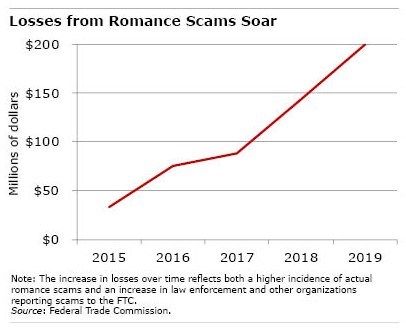
Despite the flashing red lights that say “fraud,” romance scams are becoming increasingly profitable. Last year, its victims were cheated out of more than $200 million. This is a 40 percent increase over 2018 and exceeds the losses for any other type of scam, according to the Federal Trade Commission. Middle-aged Americans, who are very active online, are the most common victims – and they’re often women. But the typical loss for someone over 70 is $10,000 – the most for any age group. Some people lose much more.
 One victim, a 76-year-old widow from Rhode Island, met her alleged perpetrator while playing Words with Friends, an online word puzzle. Over a two-year period, she gave him $660,000, which required her to refinance her home, sell property in Massachusetts, and withdraw money from her bank account.
A Texan in her 50s met a man on Facebook who claimed to be a friend of a friend. He persuaded her to turn over $2 million, which she doled out slowly over time as he promised to pay her back, told her he loved her, and arranged for them to meet. They never did.
“He was saying all the right things,” she told the FBI. “I felt there was a real connection there.” …Learn More

February 11, 2020
Most Older Americans Age in their Homes
Retirees are apparently unpersuaded that it’s a good idea to convert their substantial home equity into some retirement income.
One way to tap this home equity is through state programs that defer older homeowners’ property taxes. The programs are offered in many states, but very few people take advantage of them. Retirees are also skeptical about the benefits of converting their equity into income using a federally insured reverse mortgage: only about 50,000 older homeowners, on average, get them every year.
A big concern is that if they ever sell the house, the back taxes or the reverse mortgage must be paid back – with interest.
But a new study by the Center for Retirement Research finds that this is an unlikely scenario for the majority of retirees, because they rarely move or don’t move at all.
The researchers constructed a picture of how Americans’ living situations change between their 50s and the end of their lives by combining the data for two separate age groups. They matched the households in one group, who were between age 50 and 78, with similar but much older households in the second group and then followed the second group through most of their 90s.
The researchers found that 53 percent of this constructed sample of homeowners never moved out of the house they owned when they were in their early 50s.
Another 17 percent relocated around the time they were retiring and then generally stayed put. Although the households in this group tended to be more educated and better off financially than the people who never moved, both groups ended up with substantially more housing wealth than the people who moved frequently. …Learn More
About Squared Away

Learn more about our blog and its writer, Kimberly Blanton, a former Boston Globe reporter.
