

Posts Tagged "death rate"

April 7, 2020
Our Parents Were Healthier at Ages 54-60
Baby boomers aren’t as healthy as their parents were at the same age.
This sobering finding comes out of a RAND study that took a series of snapshots over a 24-year period of the health status of Americans when they were between the ages of 54 and 60.
The researchers found that overall health has deteriorated in this age group, and they identified the specific conditions that are getting worse, including diabetes, pain levels, and difficulty performing routine daily activities.
Obesity is an overarching problem: the share of people in this age group with class II obesity, which puts them at very high risk of diabetes, tripled to 15 percent between 1992 and 2016.
In addition to declining health, the study for the Retirement and Disability Research Consortium uncovered strong evidence of growing health disparities among 54 to 60-year-olds: the poorest people are getting sicker faster than people with more wealth.
The increase in women’s pain levels has been starkest over the past 24 years. The wealthiest women have seen an increase of 6 percentage points in the share experiencing moderate to severe pain from conditions like joint or back pain. But the poorest women saw a 21-point leap. The disparity for men was also large: up 7 points for the wealthiest men versus 15 points for the poorest men.
The bottom line: today’s 54 to 60-year-olds are not as healthy as their parents were, and the study suggests that the disparities between rich and poor will continue to grow.
To read this study, authored by Peter Hudomiet, Michael D. Hurd, and Susann Rohwedder, see “Trends in Health and Mortality in the United States.”Learn More
January 23, 2020
Medicaid Expansion has Saved Lives
The recent rise in Americans’ death rates is a crisis for the lowest-earning men. They are dying about 15 years younger than the highest-earners due to everything from obesity to opioids. Women with the lowest earnings are living 10 years less.
But healthcare policy is doing what it’s supposed to in the states that expanded their Medicaid coverage to more low-income people under the Affordable Care Act (ACA): helping to stem the tide by making low-income people healthier.
An analysis by the Center for Poverty Research at the University of California, Davis, found that death rates have declined in the states that chose to expand Medicaid coverage. The study focused on people between ages 55 and 64 – not quite old enough to enroll in Medicare.
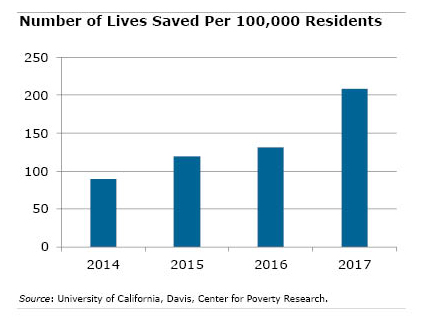 Medicaid has “saved lives in the states where [expansion] occurred,” UC-Davis researchers found. They estimated that 15,600 more lives would have been saved nationwide if every state had covered more of their low-income residents.
This is one of many studies that takes advantage of the ability to compare what is happening to residents’ well-being in states that expanded their Medicaid programs with the states that did not. Progress has come on many fronts.
In expansion states, rural hospitals, which are struggling nationwide, have had more success in keeping their doors open. By covering more adults, more low-income children have been brought into the program, which one study found reduces their applications for federal disability benefits as adults. And low-income residents’ precarious finances improved in states where Medicaid expansion reduced their healthcare costs. …Learn More
October 10, 2019
What’s Driving the Longevity Gap
The decline in U.S. life expectancy is unlike anything we’ve seen

Bombshell headlines like this popped up in major news outlets last November after the government reported that life expectancy in 2017 fell for the third year in a row.
This is a troubling break from the steady improvements in lifespans since 1900, which were powered by a combination of medical breakthroughs and healthcare policy. Early in the 20th century, antibiotics dramatically increased infant lifespans. Later, new treatments like statins and stents, as well as expanded access to healthcare through Medicare and Medicaid, increased life expectancy across the age range.
But there’s another story behind this story: life expectancy very much depends on where one falls on the economic ladder.
Between 1979 and 2011 – prior to the very recent fall in longevity – the increase in lifespans was much larger for more educated, higher-earning Americans than the gains for people with less education and lower incomes, according to a study by the Center for Retirement Research (CRR).
Smoking is an important factor in this socioeconomic divide. The decline in smoking and cardiovascular disease greatly contributed to rising longevity in the latter half of the 20th century. But while all Americans are smoking less today, those in lower socioeconomic groups still smoke much more. Today, one in four of them is a smoker, compared with just one smoker for every 10 people who attended college, the CRR found.
Looking ahead, education will remain a clear dividing line, and life expectancy will continue to depend crucially on the future prevalence and impact of smoking, as well as obesity, CRR predicted. …Learn More
About Squared Away

Learn more about our blog and its writer, Kimberly Blanton, a former Boston Globe reporter.
