

Posts Tagged "debt"

January 9, 2014
iPad Shoppers: More Likely to Buy?
A new study out of Boston College finds that e-shopping for products while grasping an iPad increases the feeling of ownership of that product – and may make you more likely to buy it.
The findings expand on a financial behavior issue explored in a popular Squared Away blog post about how the Internet has made it much easier to shop – and spend money. The new research distinguishes among the various technologies available to online shoppers and finds that the urge to buy may be even stronger when holding a touch screen device than when using a laptop or desktop computer.
The way this works is that the tactile experience of holding a product – whether taking it off the store rack or grasping the device that’s displaying it – imbues some sense of ownership, making it harder to give it up and resist buying it.
Here is an edited excerpt of an article explaining the research; the article appeared in Chronicle, a publication for Boston College faculty and staff. …Learn More
October 15, 2013
U.S. Families: Not Poor But Feeling Poor
New research shows the share of Americans who lack enough ready cash on hand for emergencies shot up in the aftermath of the Great Recession.
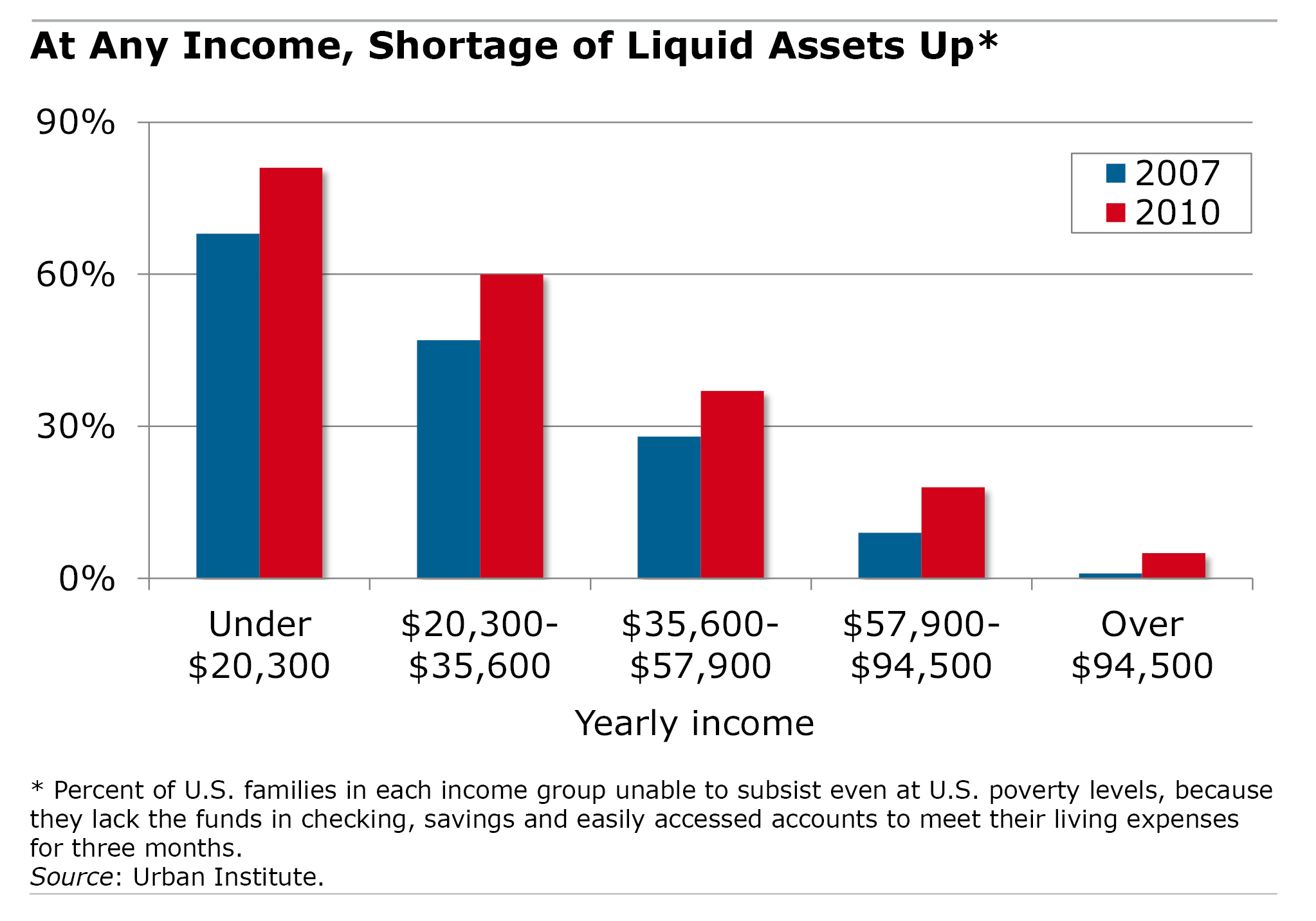 These families do not have access to the liquid assets – cash or funds in their checking or savings account – to cover emergencies like layoffs, health crises, or even car repairs, according to an analysis of federal data by Caroline Ratcliffe of the Urban Institute, who presented the finding to the Congressional Savings and Ownership Caucus in late September.
Ratcliffe’s measure of financial fragility was families who did not have enough liquid assets to subsist at federal poverty levels for three months. That amounts to $2,873 for a single person, $4,883 for a family of three, and $5,888 for a family of four.
By this measure, 37 percent of families in the middle income group – earning $35,600 to $57,900 a year – in 2010 were financially fragile – up sharply from 28 percent in 2007, a year before the Great Recession began. No income group was spared by the downturn: in most cases, the share of families at risk increased between 9 percentage points and 13 percentage points.
Ratcliffe said that financial problems can cascade if cash-poor families resort to high-cost loans or credit cards to pay their bills, and building wealth becomes extremely difficult.
“A shortage of liquid assets can lead to cycles of debt when financial emergencies arise,” creating “further financial instability,” she said.Learn More

October 3, 2013
Compulsive Spender? Blame Your Parents
There’s a bright line between an impulse purchase and compulsive spending.
When something new catches her eye, the impulsive buyer snaps it up and enjoys the splurge. There is no such enjoyment for the compulsive buyer. The act of buying temporarily alleviates her anxiety but she inevitably feels guilt or regret.
A new study explores the childhood experiences that lie at the root of why some people – women more than men – develop these damaging spending problems, which can lead to enormous debts and derail plans to save for the future.
The specific goal of the study, based on surveying 327 college students, was to shed light on the emotional pathways that can lead to compulsive buying, explained researcher Anil Mathur, a marketing professor at Hofstra University. The experiences the researchers associated with this behavior include disruptive family lives, more controlling parents, and teens who seek out peers to support their spending. …Learn More

September 3, 2013
Money Concerns Sap Mental Capacity
Poor and working people’s continual worries about money cloud their thinking and make it more difficult to perform simple tasks, concludes new research in Science magazine.
This finding came out of two very different experiments – one at a New Jersey shopping mall, the other in India’s sugar cane fields – by an international team of economists and psychologists.
In the first experiment, wealthy and low-income shoppers – $70,000 in household income was the cutoff between high and low – were seated in front of computers and quizzed about a variety of financial scenarios designed to trigger thoughts of their own money concerns.
For example, they might have been asked whether to pay for a car repair with a loan or cash or to forgo the work altogether. Some of these scenarios were relatively easy to resolve – say, the car repair cost only $150. In a difficult scenario, it might cost $1,500.
After answering a series of easy and hard financial questions, the shoppers performed simple tasks often administered by psychologists, such as picking the shape that best fits into a group of other shapes. Rich and poor performed similarly on the tasks after they were presented with the low-cost scenarios. But the high-cost scenarios caused the poor to perform significantly worse.
A brain distracted by financial problems is “like a computer slowing down when you run too many things at once,” said Eldar Shafir, a Princeton University professor of psychology and public affairs. …Learn More

August 27, 2013
Reverse Mortgage Article Hits Nerve
Readers reacting to a recent blog post about reverse mortgages fiercely debated the financial product’s pros and cons, which they felt were missing from the article.
The July 25 article noted that fewer than 55,000 older Americans in 2012 used the federally insured loans. The advantage of a reverse mortgage is that Americans age 62 or older can borrow against some of the equity in their homes to generate much-needed income or create a financial cushion. The principal and interest are repaid when the retiree or his children sell the house.
Even though reverse mortgages are rare, the topic hit a nerve with readers, including lawyers, brokers, and people with elderly parents.
A mortgage broker named D. Gardner, for example, said that he’s often seen people use reverse mortgages to maintain a lifestyle they can’t afford, eliminating a financial option they may need later in life.
For some borrowers, he said, a reverse mortgage “was a means to paper over problems.” …Learn More
August 22, 2013
More Carrying Debt into Retirement
No matter how you measure it, older Americans are falling deeper in debt.
The number of people in their 60s who have debt has grown from just under half of that age group in 1998 to nearly two out of three in 2010. And their debt, as a share of their assets, has surged during that time from 10 percent to 18 percent.
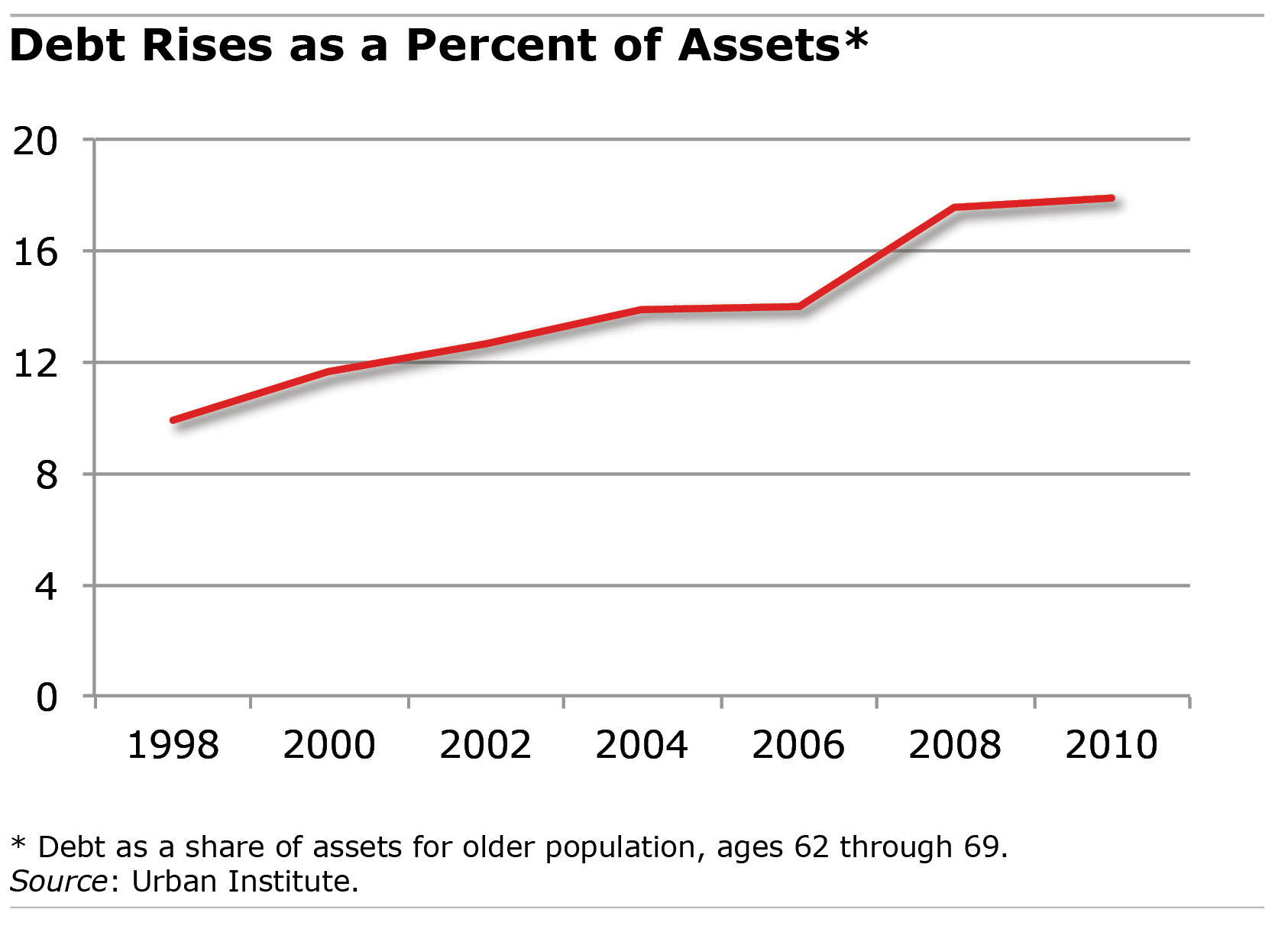 Debt is becoming increasingly common among older people, regardless of their level of income, according to Urban Institute researchers, who presented their findings at the August meeting of the Retirement Research Consortium. (The Center for Retirement Research at Boston College, which sponsors this blog, is a Consortium member.)
Among individuals with incomes that place them in the top third of incomes, the share of older people in debt increased from 57 percent to 70 percent between 1998 and 2010 – a 13 percentage point rise. But that share rose by 17 percentage points for middle-income and by 14 percentage points for low-income people. In all three income groups, the amounts owed also rose. …Learn More
August 15, 2013
Students Tell Their Tales of Debt



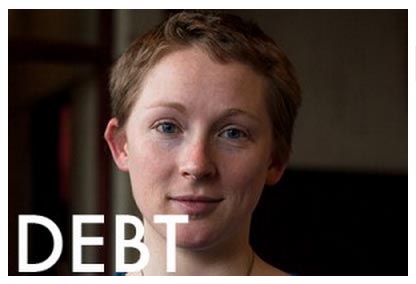
Click on each of the four photographs above to hear from the students, Kathleen Buckingham, Preston Davis, Michael McCormack, and Kelly McGowan.
Nastasia Peteuil, who paid very little for her college education in France, was shocked by how much students in this country are borrowing and by the crushing financial pressures this creates.
While taking graduate journalism courses at the University of Massachusetts in Amherst last spring, she persuaded four classmates to narrate their personal stories, which she documented on film in four short profiles.
What makes Peteuil’s profiles so powerful is that they convey, in real time, how these young adults begin to realize what their debt will mean to their lives and career choices.
Squared Away has written about the financial consequences of college loans after graduation – on buying one’s first house, on retirement, and even on graduates’ love lives.
But, as Peteuil has dramatized, the consequences begin prior to graduation day.Learn More
About Squared Away

Learn more about our blog and its writer, Kimberly Blanton, a former Boston Globe reporter.
