

Posts Tagged "employment"

March 24, 2020
If People Can Work Longer, They Will
A majority of adults believe there’s better than a 50-50 chance they will still be working full-time after age 65, a new study found.
The evidence suggests this goal is fairly realistic.
In the study, adults ranging in age from 18 to 70 were asked to rate themselves on a 1-to-7 scale for 52 different cognitive, physical, psychomotor, and sensory abilities that determine their capacity to work. These abilities run the gamut from written comprehension, pattern recognition, and originality to finger dexterity, reaction time, and vision acuity.
Of course, physical abilities decline with age. But when the researchers compared older and younger participants in the study, they found that many self-assessments of their abilities were very similar. For example, psychomotor abilities – such as hand steadiness, manual dexterity, and coordination – were at peak levels for the people in their 30s. But these abilities were only slightly diminished for the people in their 60s. And despite concerns about cognitive decline among older workers, the difference between 50- and 60-year-olds was minor.
The heart of the research, funded by the U.S. Social Security Administration, was determining whether each individual’s distinct set of abilities affected his or her work capacity, as well as how long and how much the individual intends to work as they age. This issue is important, because extending a career is a powerful way to improve one’s financial security after retirement.
To determine this capacity for work, each individual’s self-assessed abilities were matched up with the skills required to do nearly 800 different U.S. occupations. The researchers then calculated the percentage of these occupations each person would be able to do, given their education and training level.
Here are three of the central findings:
The more occupations people can do, the more likely they were to say they would work past 65.
Workers over 60 with a higher capacity to work said they would be more likely to remain employed even after 70.
One in four of the retirees with a very high capacity for work would consider “unretiring” and returning to the labor force. …Learn More

January 28, 2020
Education Could Shield Workers from AI
Not so long ago, computers were incapable of driving a car or translating a traveler’s question from English to Hindi.
Artificial intelligence changed all that.
Computers have advanced beyond the routine work they do so efficiently on assembly lines and in financial company back offices. Today, major advances in artificial intelligence, namely machine learning, have opened up a new pathway to expanding the tasks computers can do – and, potentially, the number of workers who may lose their jobs to progress over the next 20 years.
Machine learning works this way. A computer used to identify a cat by following explicit instructions telling it a cat has pointy ears, fur, and whiskers. Now, a computer can rapidly analyze and synthesize vast amounts of data to recognize a cat, based on millions of images labeled “cat” and “not-cat.” Eventually, the machine “learns” to see a cat.
But is this technological leap fundamentally different than past advances in terms of what it will mean for workers? And what about older workers, who arguably are more vulnerable to progress, because they have less time to see the payoff from updating their outmoded skills?
The answer, according to a third and final report in a series on technology’s impact on the labor market, is that advances in machine learning are likely to affect all workers – regardless of age – in the same way that computers have over the past 40 years.
And the dividing line, according to the Center for Retirement Research, will not be age. The dividing line will continue to be education: job options are expected to narrow for workers lacking a college degree or other specialized training, while jobs requiring these credentials will expand. …Learn More

January 21, 2020
Denied Disability, Yet Unemployed
Most people have already left their jobs before applying for federal disability benefits. The problem for older people is that when they are denied benefits, only a small minority of them ever return to work.
Applicants to Social Security’s disability program who quit working do so for a combination of reasons. They are already finding it difficult to do their jobs, and leaving bolsters their case. However, when older people are denied benefits after the lengthy application process, it’s very challenging to return to the labor force, where ageism and outdated skills further complicate a disabled person’s job search.
A new study looked at 805 applicants – average age 59 – who cleared step 1 of Social Security’s 5-step evaluation process: they had worked long enough to be eligible for benefits under the disability program’s rules. The researchers at Mathematica were particularly interested in the applicants rejected either in steps 4 and 5.
Of the initial 805 applicants, 125 did not make it past step 2, because they failed to meet the basic requirement of having a severe impairment. In step 3, 133 applicants were granted benefits relatively quickly because they have very severe medical conditions, such as advanced cancer or congestive heart failure.
The rest moved on to steps 4 and 5. Their applications required the examiners to make a judgment as to whether the person is still capable of working in two specific situations. In step 4, Social Security denies benefits if an examiner determines someone is able to perform the same kind of work he’s done in the past. In step 5, benefits are denied if someone can do a different job that is still appropriate to his age, education, and work experience.
In total, just under half of the 805 applicants in the study did not receive disability benefits. …Learn More

March 21, 2019
Men Who Work Longer, Live Longer
In 2007, the majority of workers in The Netherlands were retiring by their early sixties to take advantage of the country’s generous pension scheme. Then came a sweeping 2009 policy that rewarded older workers with a tax break if they remained employed and active.
In a new study, researchers used this tax break – the Doorwerkbonus, or continued work bonus – to ask the question: do people who worked longer in response to this policy also live longer? The short answer is “no” for women but “yes” for men. Delaying retirement increased men’s lifespans by three months, compared with a group that was not eligible for the bonus, possibly because working longer improved their health.
The tax break was the equivalent of a wage increase for all older workers in every sector of the Dutch economy. The bonus started as a 5 percent tax cut for working people in the year they turned 62, increased to 7 percent at 63, and 10 percent at 64. After that, the rewards from work dwindled, falling to 1 percent for everyone over 67. (In 2013, the size of the tax break was reduced.)
Prior to the new study, other researchers had examined whether earlier retirements caused people to die younger. But Alice Zulkarnain and Matthew Rutledge at the Center for Retirement Research took the opposite tack. They asked: were the Dutch living longer because they delayed retirement after the Doorwerkbonus went into effect?
While the policy did increase men’s life spans slightly, women seemed unaffected, because fewer of them responded to it by working longer.
Is there a lesson in the Doorwerkbonus for American boomers? This study indicates that working longer will not only put more money in retirees’ pockets, it might also add to their life spans. …Learn More
February 26, 2019
Baby Boomer Labor Force Rebounds
One way baby boomers adjust to longer lifespans and inadequate retirement savings is to continue working. There’s just one problem: it can be more difficult for some people in their 50s and 60s to get or hold on to a job.
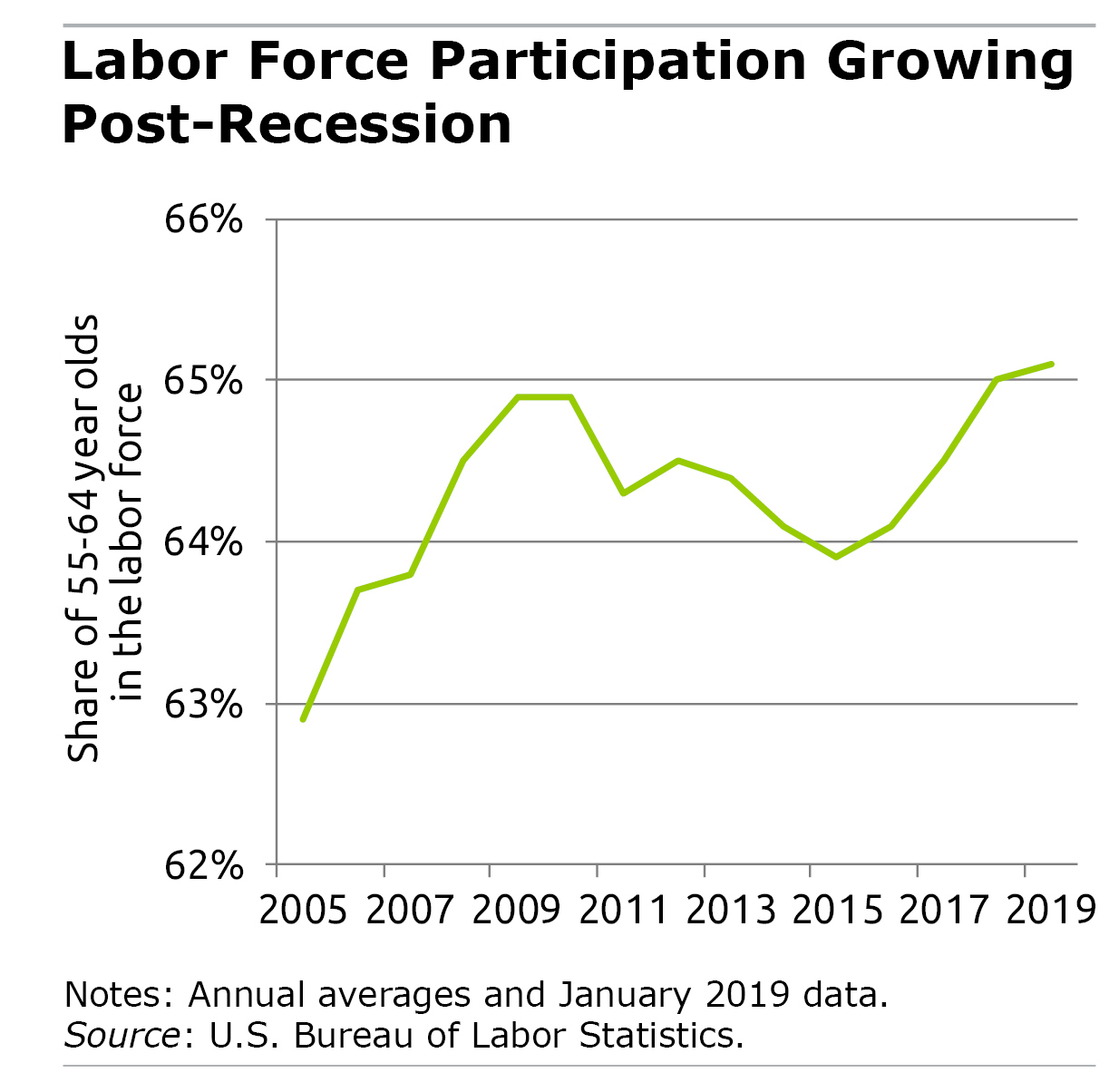 But things are improving. The job market is on a tear – 300,000 people were hired in January alone – and baby boomers are jumping back in. A single statistic illustrates this: a bump up in their labor force participation that resumes a long-term trend of rising participation since the 1980s.
In January, 65.1 percent of Americans between ages 55 and 64 were in the labor force, up smartly from 63.9 percent in 2015. This has put a halt to a downturn that began after the 2008-2009 recession, which pushed many boomers out of the labor force. The labor force is made up of people who are employed or looking for work.
The recent gains don’t seem transitory either. According to a 2024 projection by the U.S. Bureau of Labor Statistics, the older labor force will continue to grow. The biggest change will be among the oldest populations: a 4.5 percent increase in the number of 65- to 74-year olds in the labor force, and a 6.4 percent increase over age 75. …Learn More
About Squared Away

Learn more about our blog and its writer, Kimberly Blanton, a former Boston Globe reporter.
