

Posts Tagged "manage money"

May 29, 2014
More Plan Funerals Than Plan Elder Care
More adults are planning their funerals than are making arrangements for care in their final years of life.
That’s among the revealing findings about how Americans grapple with the inevitabilities of old age in an annual survey about U.S. attitudes toward long-term care. More than 1,400 adults were surveyed in March and April by the Associated Press-NORC Center for Public Affairs Research. (NORC is a social science research organization affiliated with the University of Chicago.)
“Experts believe that, like any other long-term financial planning, long-term care planning is the kind of thing you should get started with as soon as possible,” said Jennifer Benz, a senior research scientist for AP-NORC. But for many people, “it’s not even on their radar,” she said.
Nearly two out of three adults over age 40 said they have discussed funeral plans with family or others they trust, and more than half have also created a so-called advanced directive specifying how they would like their medical care to be handled if they become incapacitated.
While death and mortal illness are on people’s minds, there’s scant thinking about their long-term care arrangements. More than two-thirds reported they have done “little or no planning” for how they’ll be cared for in old age. …Learn More

May 13, 2014
Spending Cut When Job Threats Rise
A new study provides important insights into American workers’ household budgets.
The study found that when workers sensed a growing likelihood they might lose their jobs, they quickly pared their spending on a large and diverse basket of discretionary consumer goods. These included both standard purchases and big-ticket items, from gardening supplies and vacations to cars and dishwashers.
The analysis was based on a survey of some 2,500 workers who were asked about their spending patterns and also asked to estimate their own chances of becoming unemployed over the coming year. The survey was conducted between 2009 and 2013, when the U.S. jobless rate at one point approached 10 percent. …Learn More
April 29, 2014
Pay Gap: Depends on Woman’s Age
The earnings gap between working men and women has narrowed somewhat over time, but it’s considerably wider for older women.
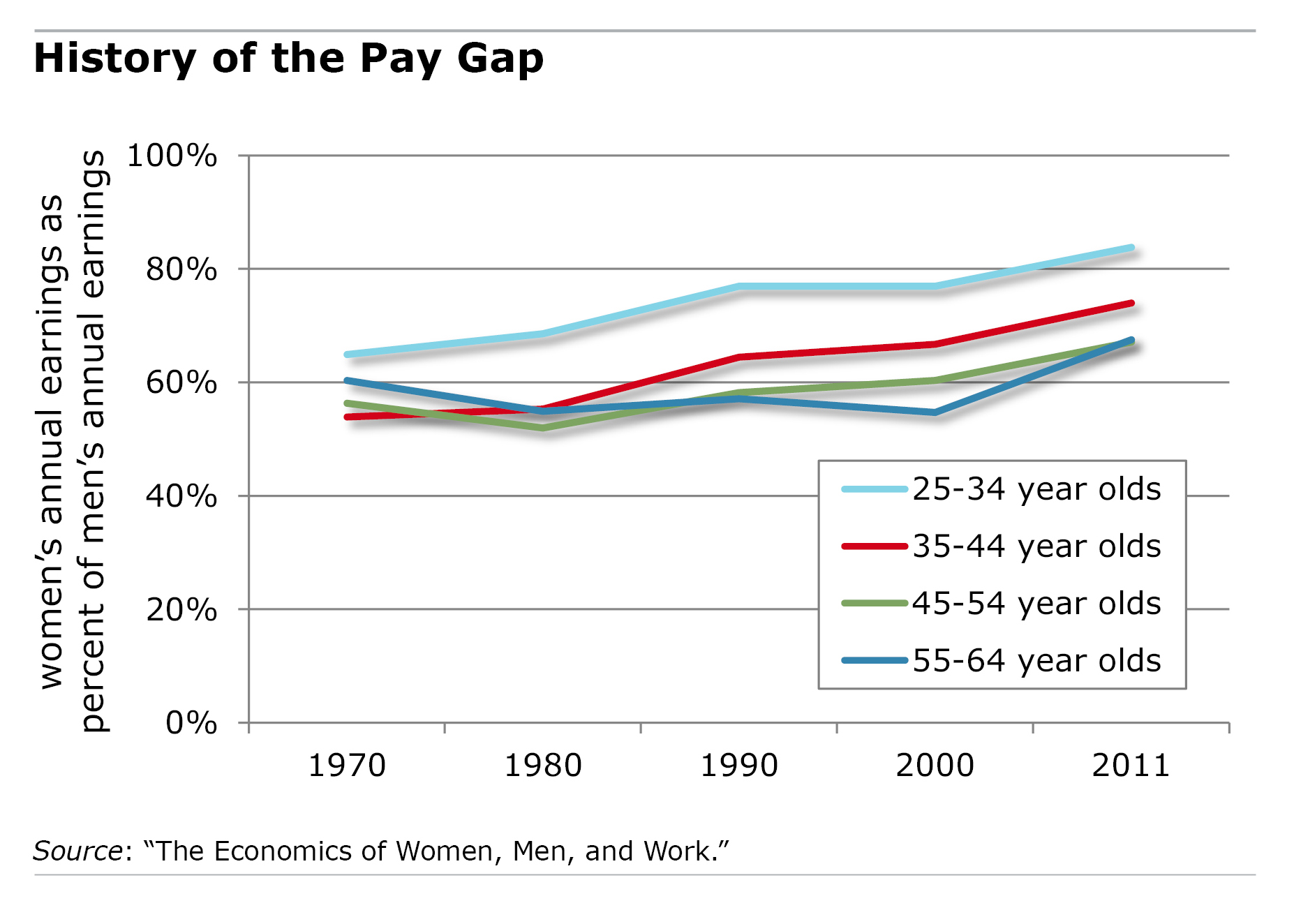 Women who are now on the cusp of retirement and working full-time earn 67.5 cents for every dollar men their age earn – or 8 cents more than working women who were the same age (in their late 50s and early 60s) during the 1970s.
For younger women, the pay gap persists but things are brighter. Women in their late 20s and early 30s today earn 84 cents for every dollar a young man earns. That’s a 20 cent gain over women who were their age back in 1970.
These are among the myriad statistics documenting the history of the pay gap in the new (7th) edition of the economics textbook, “Economics of Women, Men, and Work.”
The pay gap affects women’s ability to save, buy a house, and invest. There are several explanations for why younger women have made more progress, relative to men, say the textbooks’ authors, Francine Blau, Anne Winkler, and Marianne Ferber: …
Learn More
April 24, 2014
Should a Will Even the Score?
Consider this difficult situation: An elderly woman lends her oldest son $20,000 to help pay for some expensive medical care for his teenage son – her grandson – who’s stricken with cancer.
When the woman writes her will, a different son who is also her executor – and happens to be an accountant – advises her to deduct the $20,000 loan, never repaid, from the oldest son’s modest inheritance.
This happened in my family, and I was of two minds at the time. Technically, the money was a loan – not a gift – so not paying it back was unfair to the other siblings who didn’t receive $20,000. But it seemed uncompassionate to take the money out of a bequest, given the graveness of the teenager’s illness.
Financial planner Rick Kahler discusses a similar situation in this video and proposes something that may seem radical: evenly dividing up your estate isn’t necessarily fair.
The way Kahler explains his argument in the video, it makes sense – at least in the particular instance he’s discussing. But does it depend on the situation? …Learn More
April 8, 2014
1 in 4 Seniors Have Little Home Equity
 Retirees can use the equity sitting in their homes to pay for their daily expenses, out-of-pocket medical bills or nursing care, especially toward the end of their lives.
Cash-strapped older retirees can access that equity by taking out reverse mortgages or home equity loans or by downsizing to less expensive homes or condominiums.
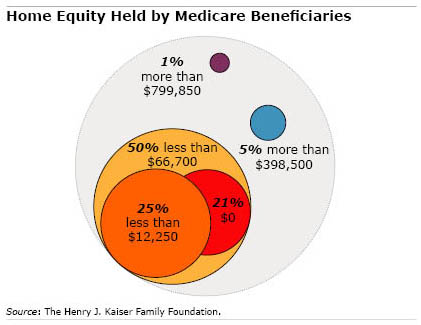
But one in four Medicare recipients has less than $12,250 in home equity, according to a new report by the Kaiser Family Foundation, a healthcare non-profit.
Kaiser’s calculations also show that the distribution of home equity among older Americans is – like the distribution of income and financial assets – top heavy. While 5 percent of Medicare beneficiaries in 2013 had more than $398,500 in home equity, half have less than $66,700.
According to Kaiser’s projections, that gap will widen in the future. By 2030, those whose home equity places them in the top 5 percent will see that equity grow more than 40 percent, but it will rise less than 10 percent for those with mid-level – or median – amounts of equity.
The analysis was part of a study to examine the ability of older Americans to absorb rising out-of-pocket retiree medical costs and increasing Medicare premiums. This blog also reported the study’s similarly grim findings about the meager financial savings held by many retirees to cover their health care costs.Learn More

April 1, 2014
Many with Dementia Manage Finances
When dementia enters an elderly couple’s home, it can bring financial mismanagement with it.
But since both spouses don’t usually become cognitively impaired at precisely the same time, couples have the option of turning over the household financial responsibilities to the person who’s not yet impaired. The question is whether this transfer of control happens quickly enough.
Most couples are waiting until after cognition is very low to make this change, according to a new study.
Economists Joanne Hsu with the Federal Reserve Board and Robert Willis with the University of Michigan found that 80 percent of married older Americans who had been in charge of their household finances continued to manage them after a test revealed they were approaching or already experiencing dementia. …Learn More
March 4, 2014
New Book Spotlights Behavioral Finance
 Did you know that an investor may be more likely to hold on to a money-loser if he bought it himself than if he inherited it? That people born with the “warrior gene” will take more risks? Or that trust is essential to whether individuals prepare for retirement?
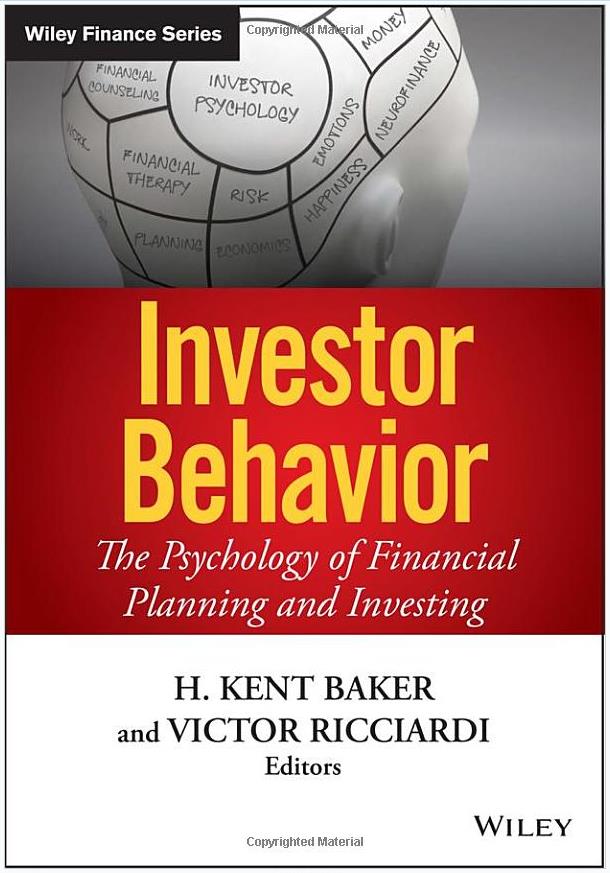
A new edited volume, “Investor Behavior: the Psychology of Financial Planning and Investing,” is a thorough tour of the research on these and other aspects of behavioral finance. The book was compiled for financial planners, investment professionals, academics, and finance students and edited by two finance professors, H. Kent Baker of American University’s Kogod School of Business and Victor Ricciardi of Goucher College.
The field of behavioral finance is gaining traction as financial experts increasingly recognize that psychology, sociology, neurology and other fields may have something to say about why people behave the way they do around money.
Traditional theories explaining investor behavior, such as modern portfolio and utility theory, assume that people make “rational” choices. In contrast, the research covered in this new book tries to explain why financial decisions are not always rational, are often infused with emotion, and can be very predictable. Or, as 1978 Nobel laureate Herbert Simon once explained, orthodox finance’s “traditional paradigm did not describe the behavior of real people,” the book says. …Learn More
About Squared Away

Learn more about our blog and its writer, Kimberly Blanton, a former Boston Globe reporter.
