

Posts Tagged "manage money"
October 29, 2013
Homes More Affordable – For How Long?
There was a silver lining in the recent housing market collapse: prices dropped to more affordable levels for American families who didn’t already own.
Buying still isn’t easy. It’s become more difficult to qualify for a mortgage from banks and other lenders that have tightened up their credit qualifications. But the following chart, which also appears on page 11 of a chartbook released by the Urban Institute’s new Housing Finance Policy Center, shows the dramatic improvement in home affordability in the wake of the market’s recent downturn.
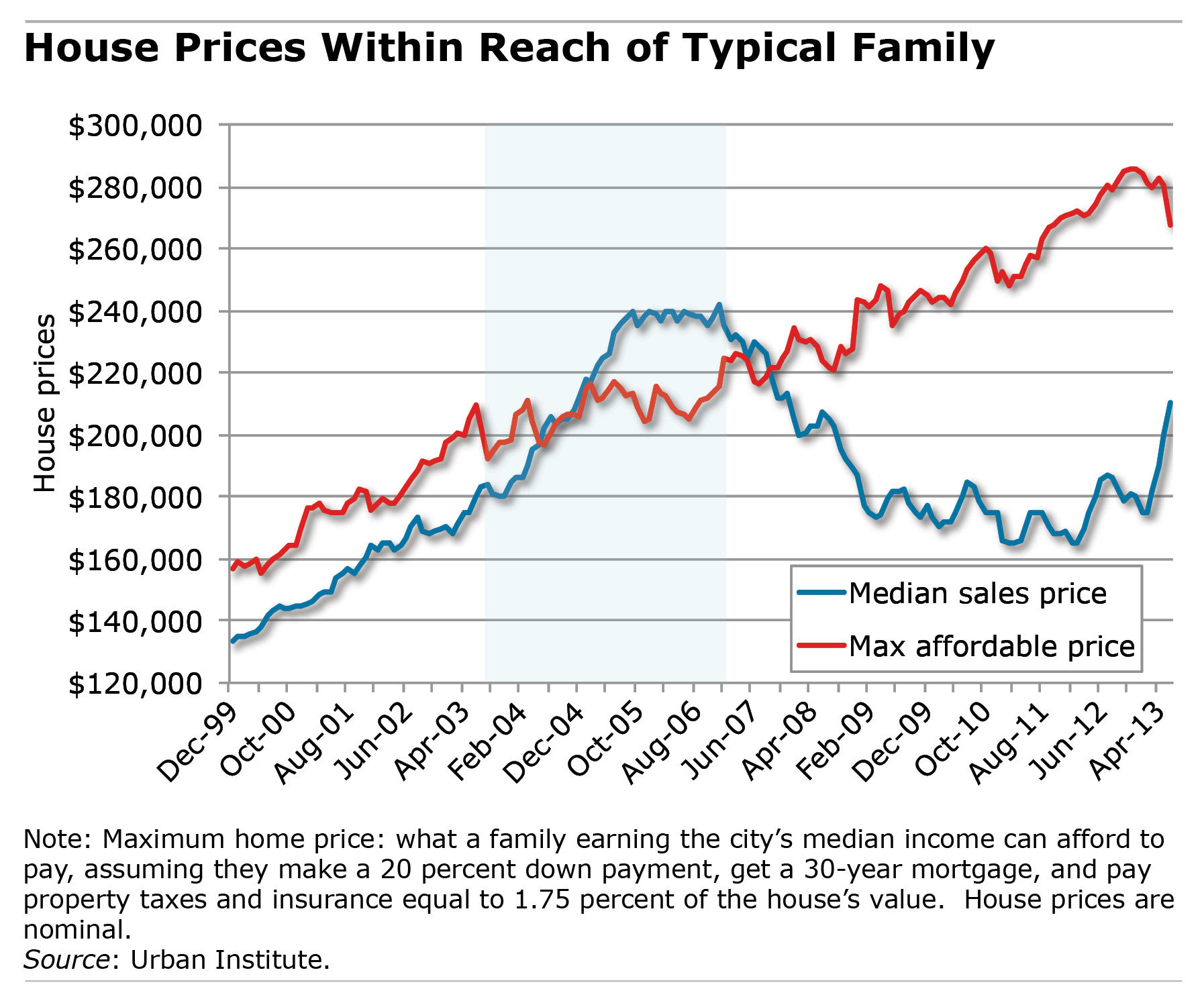 The blue line shows actual house prices over time – that’s the median, or middle, price for every single home sold nationwide in a given year. The red line shows the maximum a typical family can afford, assuming they put down 20 percent and get a 30-year mortgage at the prevailing interest rate, which is currently about 4.1 percent.
During the credit bubble, the blue price line surged above the maximum, putting a new house out of reach for many more families. Post-crash, that relationship reversed, making homes more affordable again.
But affordability still varies greatly, depending on where you live. … Learn More
October 17, 2013
Video: Mutual Funds or Designer Shoes?
Prithi Gowda’s animated video was one of two winners in a competition among New York University film school students and alums to produce a video that would turn young adults on to mutual funds. The winners were awarded a trip to Monaco to premier their work.
The filmmaker practices what she preaches in this short animation, “Frenemies.” Gowda’s freelance work as a website designer and videographer for Wall Street firms has allowed her to build up “a nice, comfortable savings.” Investing, she said, has given her the freedom to start her own company, 21st Street Projects in Manhattan.
“I just feel strongly the world could be a much better place if people really understood how to deal with their finances,” Gowda said.Learn More
October 15, 2013
U.S. Families: Not Poor But Feeling Poor
New research shows the share of Americans who lack enough ready cash on hand for emergencies shot up in the aftermath of the Great Recession.
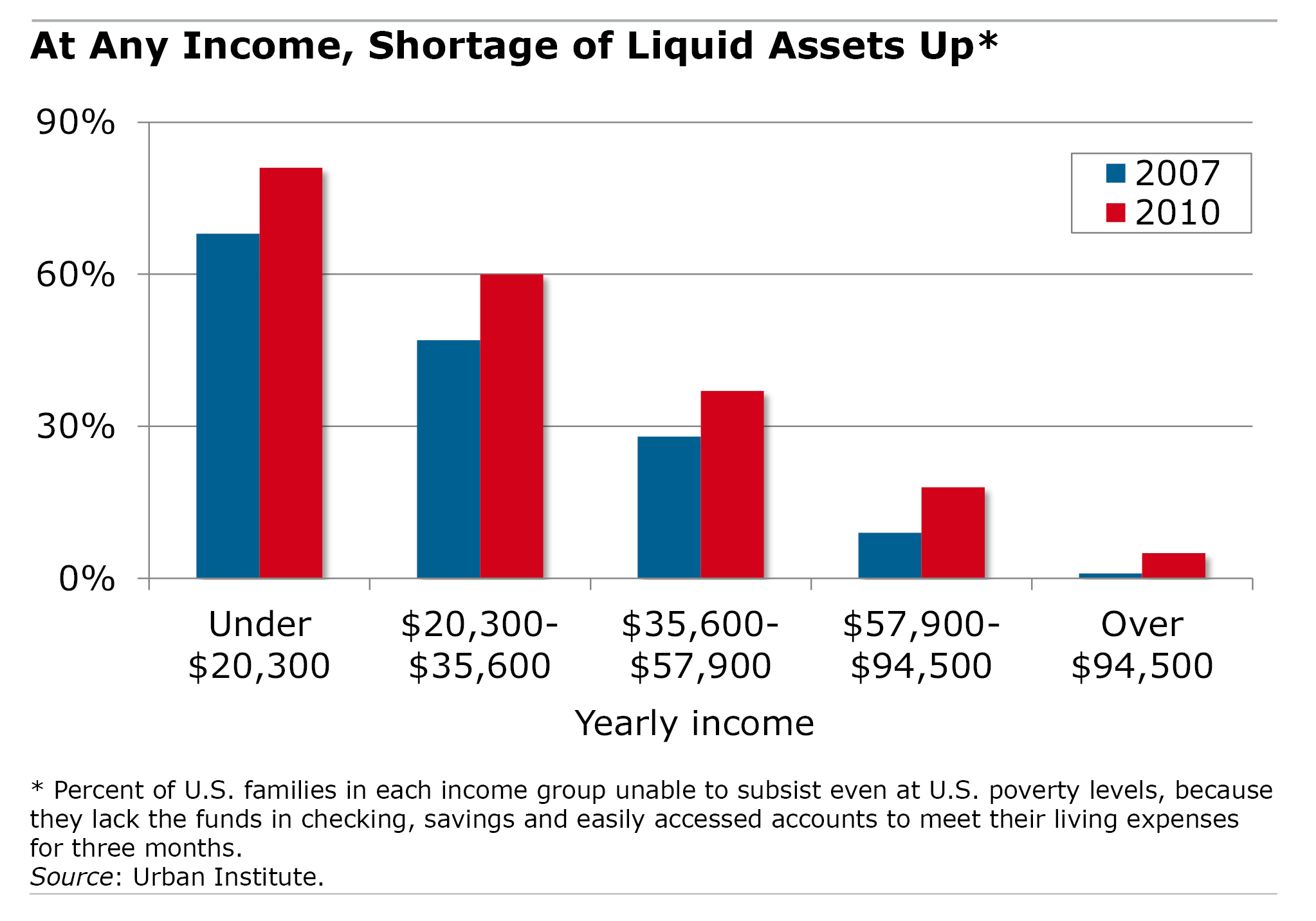 These families do not have access to the liquid assets – cash or funds in their checking or savings account – to cover emergencies like layoffs, health crises, or even car repairs, according to an analysis of federal data by Caroline Ratcliffe of the Urban Institute, who presented the finding to the Congressional Savings and Ownership Caucus in late September.
Ratcliffe’s measure of financial fragility was families who did not have enough liquid assets to subsist at federal poverty levels for three months. That amounts to $2,873 for a single person, $4,883 for a family of three, and $5,888 for a family of four.
By this measure, 37 percent of families in the middle income group – earning $35,600 to $57,900 a year – in 2010 were financially fragile – up sharply from 28 percent in 2007, a year before the Great Recession began. No income group was spared by the downturn: in most cases, the share of families at risk increased between 9 percentage points and 13 percentage points.
Ratcliffe said that financial problems can cascade if cash-poor families resort to high-cost loans or credit cards to pay their bills, and building wealth becomes extremely difficult.
“A shortage of liquid assets can lead to cycles of debt when financial emergencies arise,” creating “further financial instability,” she said.Learn More

October 8, 2013
Got a 401k? A Guide for New Retirees
Upon retiring, you suddenly have access to a chunk of money that’s been accumulating in your 401(k). It’s easy to make a move that incurs unfamiliar tax consequences or otherwise jeopardizes your hard-earned savings.
Based on interviews with financial planners, as well as experts at the Center for Retirement Research, which funds this blog, Squared Away assembled the following check list for imminent and new retirees:
- At least one year before retiring, collect information from:
- Social Security – how does your monthly check vary, depending on the filing age you select, and how can you and your spouse determine the best strategy for getting the benefits you’ll need?
- Your employer – is an annuity an option in your 401(k) plan, or how much can you expect to receive per month from a defined benefit pension?
- A fee-only planner or other financial resources – what are your priorities and options; how much retirement income do you need; do your Social Security, 401(k) savings, and employer pensions generate enough income, and with how much risk; should you delay Social Security to increase your total monthly income; and should you purchase an annuity to cover your fixed expenses?
“Make sure before you stop working that you’re financially prepared to do so,” said John Spoto, owner of Sentry Financial Planning in Andover, Mass., near Boston. …

October 3, 2013
Compulsive Spender? Blame Your Parents
There’s a bright line between an impulse purchase and compulsive spending.
When something new catches her eye, the impulsive buyer snaps it up and enjoys the splurge. There is no such enjoyment for the compulsive buyer. The act of buying temporarily alleviates her anxiety but she inevitably feels guilt or regret.
A new study explores the childhood experiences that lie at the root of why some people – women more than men – develop these damaging spending problems, which can lead to enormous debts and derail plans to save for the future.
The specific goal of the study, based on surveying 327 college students, was to shed light on the emotional pathways that can lead to compulsive buying, explained researcher Anil Mathur, a marketing professor at Hofstra University. The experiences the researchers associated with this behavior include disruptive family lives, more controlling parents, and teens who seek out peers to support their spending. …Learn More
September 19, 2013
Make-up of Non-Bank Customers Changes

Nicole DeConinck. Photograph by Adele M. Pleatman.
Having cashed her McDonald’s paycheck at a check cashing outlet in Boston’s South End neighborhood, Nicole DeConinck has completed one half of her Friday afternoon ritual.
She will now walk to a nearby pharmacy to purchase a debit card, which she’ll use to make her purchases.
More Americans like DeConinck say they have used non-traditional financial services, such as check cashing, or are getting loans from places like pawn shops, payday lenders, or firms that offer advances on IRS refunds. In 2011, 41 percent had, up from 36 percent in 2009, according to the Federal Deposit Insurance Corp., which insures U.S. commercial banks.
One thing fueling this growth is that non-bank loans, which are ready sources of cash, are reaching new segments of the American public, according to a recent analysis of the FDIC’s data by Gregory Mills and William Monson of the Urban Institute in Washington. Once associated with minorities, immigrants and low-income workers, they found they’re more prevalent among non-Hispanic whites, college graduates, and people who earn more than $50,000.
“It’s a measure of the extent of distress throughout the American economy that more and more individuals regarded as insulated from having to turn to these kinds of borrowed funds are now having to access them,” Mills said. …Learn More
September 17, 2013
Workers Struggle Day to Day
There’s a growing concern that working people aren’t saving for the future, but the reality is that many of them can barely get by in the here and now.
A sizable minority of Americans say they are spending more than they earn, have overdue medical bills, or pay only the minimum on their credit cards. These were among the findings in the 2012 National Financial Capability Study (NFCS) conducted by the FINRA Investor Education Foundation, its second survey to illuminate the day-to-day financial issues facing average working people.
Pulling together $2,000 may seem like only a modest challenge for someone with good pay and benefits. But 40 percent of the people surveyed also indicated they would be hard-pressed to find that much money if they needed it, according to a September report on the NFCS survey.
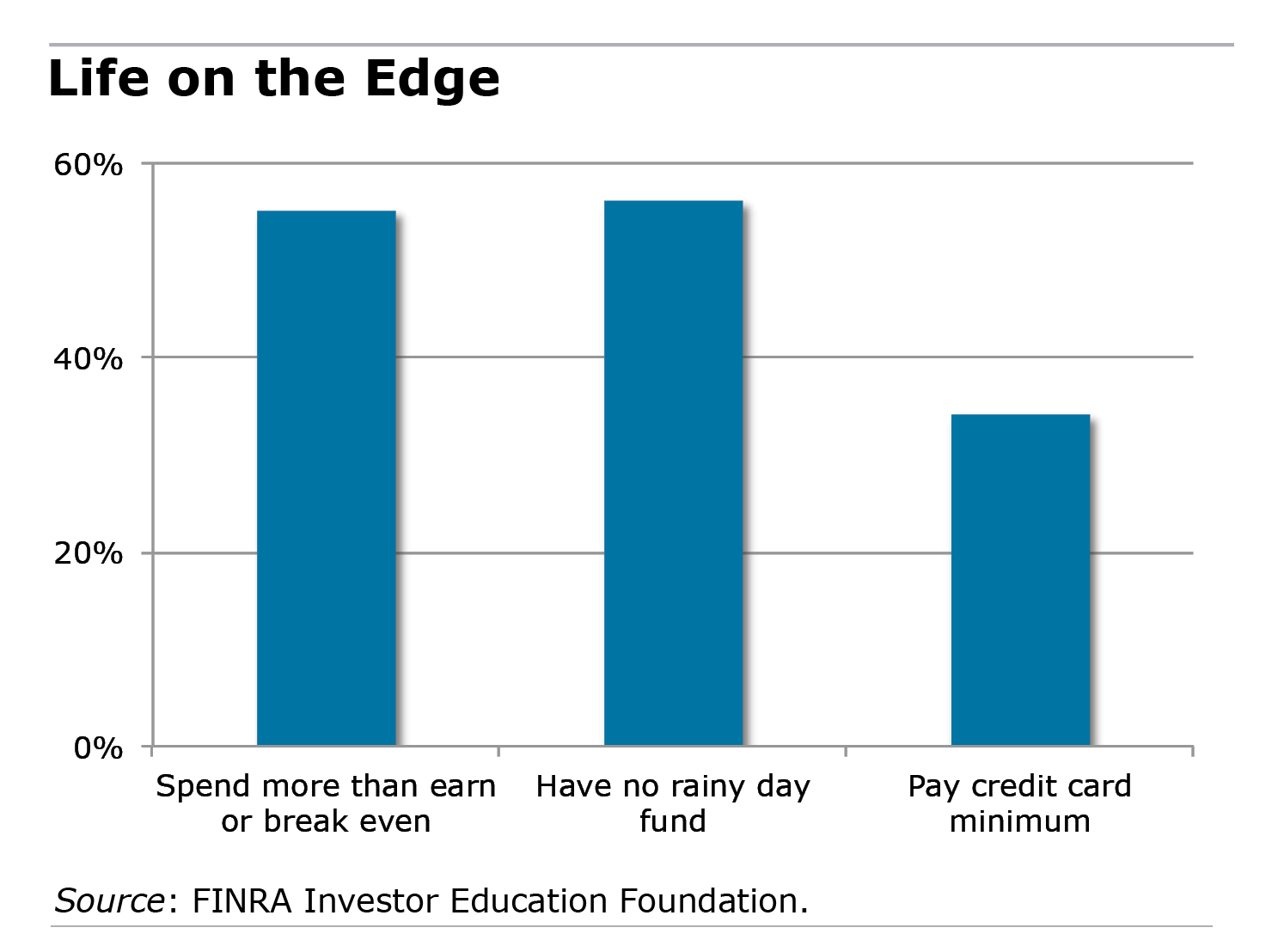 FINRA identified indicators of what it called the “financial fragility” of the average American:
• More than half of those surveyed were in a poor position to save: 19 percent spend more than they earn, and 36 percent just break even.
• More than half have no rainy day fund and live paycheck-to-paycheck. …Learn More
About Squared Away

Learn more about our blog and its writer, Kimberly Blanton, a former Boston Globe reporter.
