

Posts Tagged "manage money"
February 19, 2013
Boomers Still Cautious About Stocks
Mutual fund investors poured some $17 billion into domestic equity funds in January, reversing 2012’s trend, according to the Investment Company Institute (ICI), an industry trade group.
But it’s too early to declare that fund investors have fully recovered from the 2008 market collapse, even as the bullish S&P500 stock market index flirts with its 1,565 all-time high reached on October 9, 2007.
Fund investors surveyed by ICI still remain less willing than they were prior to the big bust to take what the survey questionnaire calls “above-average or substantial risks” in their investments.
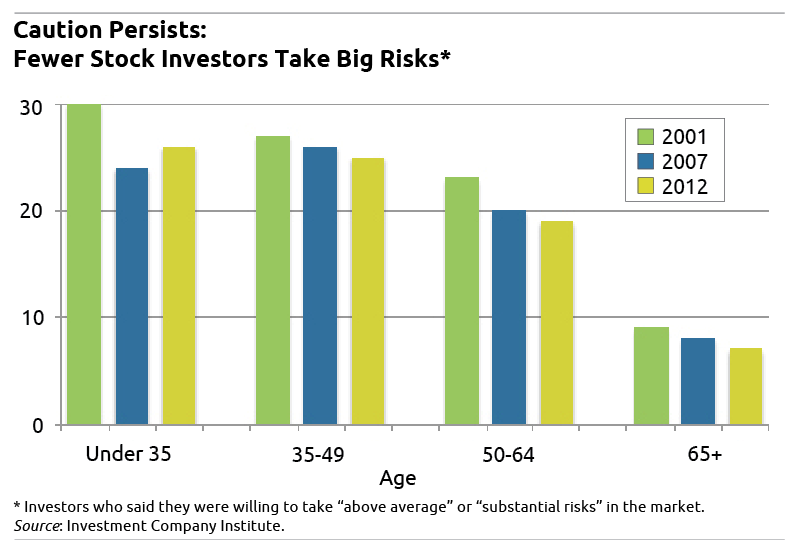 This trend cuts across most age groups, from 40-somethings to retirees. The exception is the under-35 crowd: 26 percent identified themselves as being in these higher-risk categories, slightly more than the 24 percent who did back in 2007.
But boomers nearing retirement and current retirees burned in the 2008 market collapse keep paring back their risk profiles. Older investors are moving “from capital appreciation to capital preservation,” said Shelly Antoniewicz, an ICI senior economist. Even 35-49 year olds, who still have two to three decades of investing ahead of them, are not quite back to where they were earlier in the decade when they were more willing to take risks in the stock market.
“What we have seen historically is that there is a relationship between stock market performance and inflows into equity funds. When the stock market goes up, we tend to get larger inflows into equity funds,” she said. “What we’ve noticed in the past two to four years is this historical relationship has gotten weaker.” …Learn More
January 31, 2013
Tally Your Mutual Fund Fees Here
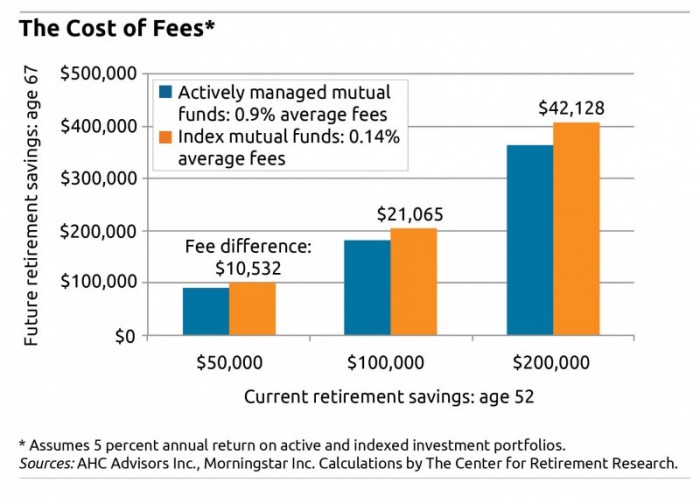
Those mutual fund fees sure add up fast.
“The average person has no idea” how much fees and expenses sap from their investments, said Ted Leber, a retiree who was a staffer with the Chief of Naval Operations and a financial adviser to service members.
The career Navy man said he was a failure after retiring to become an adviser, because he kept steering clients to low-fee mutual funds that replicate index returns, such as the S&P 500 or NASDAQ tech-stocks. The index funds helped his clients but not his firm’s profits.
Squared Away interviewed Leber after he emailed a nifty fee calculator, which was put online as a public service by AHC Advisors Inc.’s president, Craig Larsen, in St. Charles, Illinois.
Larsen and Leber join a growing number of academics, financial planners, and investors balking at the high fees middle-income investors pay for mutual funds that are actively managed by stock pickers. Fees are “costly for the average employee” and “can take a substantial toll on their retirement,” according to a study by the Center for Retirement Research at Boston College, which supports this blog.
Test the employee calculator yourself. First, look at the conservative assumptions Squared Away used to calculate fees on three portfolios, as shown in the above chart…Learn More
January 24, 2013
Boomers Delay Retirement, Earn More
Reflecting the sea change in lifestyles for the over-65 set, the share of their total income that America’s elderly earn from working has almost doubled over the past two decades.
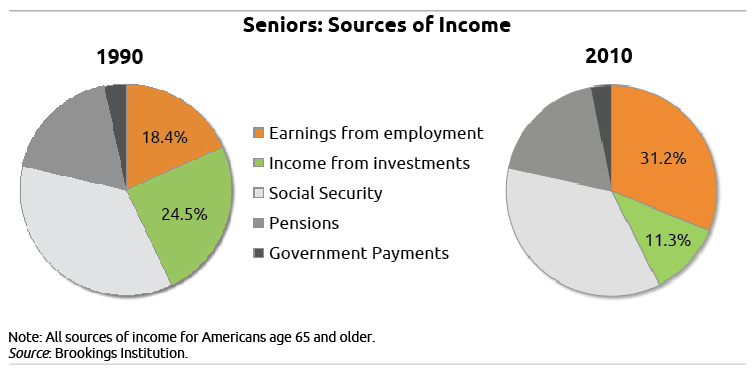
That’s a central conclusion of research by the Brooking Institution’s Barry Bosworth and Kathleen Burke, who compared the 1990 and 2010 sources of income for the nation’s age 65-plus population in a paper funded by the Retirement Research Consortium, which supports this blog.
Some things haven’t changed. The share of the elderly’s income that comes from Social Security, employer pensions and – for the poor – government aid such as welfare has hardly budged over the past two decades.
But the earnings the elderly derive from employment soared from 18 percent of their total income in 1990 to 31 percent currently. The primary reason is that more Americans are working longer and delaying retirement, a multifaceted response to better health, more education and – at least for some – growing financial insecurity. …Learn More
January 22, 2013
Olen Explains ‘Pound Foolish’
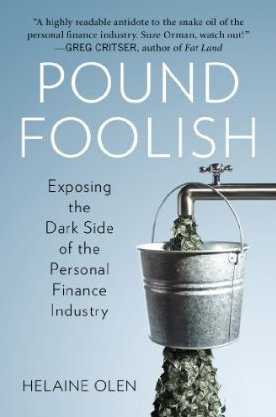 New York journalist Helaine Olen lit up Twitter last week with her new book, “Pound Foolish: Exposing the Dark Side of the Personal Finance Industry.” She has attracted high praise – from The Economist, The New York Times, and others – and a few critics, in the online community and at Business Week: “Financial professionals,” Business Week wrote, “are not responsible for knitting the safety net, though Olen makes it sound as though they are.”
Squared Away asked Olen to explain her thinking behind the book.
Squared Away: Let’s get this out of the way. What do you have against financial planners?
Olen: I don’t have anything against all financial advisers, but a lot of people are selling themselves as experts in things they are not expert in. I believe that their commissions are almost inherently conflicted. I also believe that the minute you start selling things as, “I can protect you. I can do better than…,” you’re getting into dangerous territory, because it’s simply not true.”
Are there situations in which financial planning services are useful?
I would never want anyone to think I don’t believe a good, non-conflicted financial planner or coach isn’t useful. They are, very much so. I think very few of us actually see ourselves honestly, and we could all use an objective eye looking over things like our money and investing strategies at least occasionally. But consumers need to know how their chosen advisers are compensated and if that method of compensation can influence their recommendations and strategies.
You say, “No amount of savvy or money management can fully protect” people from a punishing economy that pummels wages and erodes high-quality employment. Are average individuals blamed for troubles that are larger than they are?
Olen: I absolutely think this sort of sentiment – the idea that we will all be okay if only we learn proper money management – is an excuse to blame people for their troubles. Since the late 1970s, a massive inequality issue has opened up. We have very little class mobility in our country. We know that our net worth plunged by 40 percent in 2007-2010. To turn around and tell people that their issues are all their fault is naïve at best and it’s an outright lie at worst. …Learn More

January 15, 2013
401(k) Mutual Funds Mediocre
A spate of research in recent months shows that the mutual funds offered in employer 401(k)s have fairly unremarkable – though not disastrous – investment performance.
As with any academic study worth its salt, the various authors’ findings are complex and loaded with critical twists, turns, and footnotes. Descriptions of three research papers on 401(k) plan returns can be found by clicking “Learn More” below. But here’s the gist:
- So-called Target Date Funds – investments are based on each employee’s planned retirement age – perform better than investments guided by financial advisers hired by one Oregon employer to advise its workers. TDFs also outdo employees who go it alone.
- When the 401(k) plan’s trustee is also a mutual fund management company, it’s more reluctant to remove its own, poorly performing funds from the plans’ smorgasbord of funds.
- Employers select mutual funds that outperform a portfolio of randomly selected funds but underperform passive indexes.
There’s a common thread in many of these studies: the extra fees that investors pay for advice or the stock pickers who manage their mutual fund often don’t translate to better returns… Learn More
December 18, 2012
Music as Money Metaphor
To get a grip on retirement worries, overwhelming student loans, or squeaking by, it always helps to get more money or make a plan.
But finding a way to think about how to manage your money is also useful. It’s like making music, says Timothy Maurer, a Baltimore financial planner. At first, you have to master the “boring stuff, but eventually real songs start being produced.”
p.s. Maurer said that his brother Jon Maurer, who is “a far more accomplished musician than I,” is the pianist in this video.
To support our blog, readers may want to sign up for e-alerts – just one a week – by clicking here. Or like us on Facebook!
Learn More

December 13, 2012
Financial Planners Diversify: Four Types
Brokers, registered investment advisers, fee-only, commission-based, dual license – the labels for financial planners can be intimidating.
In a consumer-friendly article, the Retirement Income Journal (RIA) in November identified four adviser types, based on what they do for their clients.
Most advisers still fall into the traditional Technician category. But the rise of other types – Strategist, Behaviorist, and Life Coach – partly reflects a profession rocked by the 2008 financial crisis. The number of advisers nationwide fell 3 percent last year, according to Cerulli Associates in Boston.
“[T]he combined impact of the financial crisis, boomer retirement, the advent of behavioral economics and fee compression is forcing more advisers to evolve,” RIA explained.
The following is an adaptation of RIA’s article, which was based on a presentation to the University of Pennsylvania’s Wharton School of business by fee-only advisers Paula Hogan in Milwaukee and Rick Miller in Boston.
The new year is around the corner, and perhaps you’ll want to hire a planner. But which of the following four types suits you? …Learn More
About Squared Away

Learn more about our blog and its writer, Kimberly Blanton, a former Boston Globe reporter.
