
Posts Tagged "psychology"

July 5, 2012
Public Perplexed About Annuities
Sales of annuities are slow, because most retirees simply don’t know how to assess their value, new research concludes.
Many of the nation’s top retirement experts agree that annuities are the best solution for retirees struggling with the best way to invest and spend a lifetime of savings.
Annuities have a singular benefit: they guarantee monthly income, no matter how long the retiree lives – something a savings account can’t always do. This constant, pre-determined stream of income has the added advantage of preventing financial mistakes as the elderly lose cognitive capacity, according to Harvard economist David Laibson. Smart Money magazine has dubbed annuities “dementia insurance.”
Yet sales of fixed and variable annuities have been largely flat over the past decade. This “annuity puzzle” has befuddled the academy for years.
Research by the Financial Literacy Center, a joint effort by George Washington University, the Wharton School, and the Rand Corporation, concluded that most people avoid annuities – they “stick to the status quo” – because they don’t understand how they work.
“How can they make these decisions if they don’t understand what a good decision is?” said a Rand senior economist and one of the paper’s co-authors, Arie Kapteyn. “We have to do something about the fact that people have to make these decisions” about managing their retirement wealth. … Learn More
June 28, 2012
Edited Volume of Research – and More
Resources that may interest Squared Away readers keep coming over the transom. Check out new federal guidelines on what to ask a financial adviser or broker, an edited volume of academic research on financial literacy and behavior, iPhone investment apps, or a summer financial thriller.
 On Interviewing Financial Advisers:
Is hiring a financial adviser or broker daunting? How do you know you can trust him or her? These are complex issues, but the U.S. Department of Labor has just released a list of questions that provide a good start to your search. And click here for more such questions, based on research by Boston University law professor Tamar Frankel.
On Financial Behavior Research:
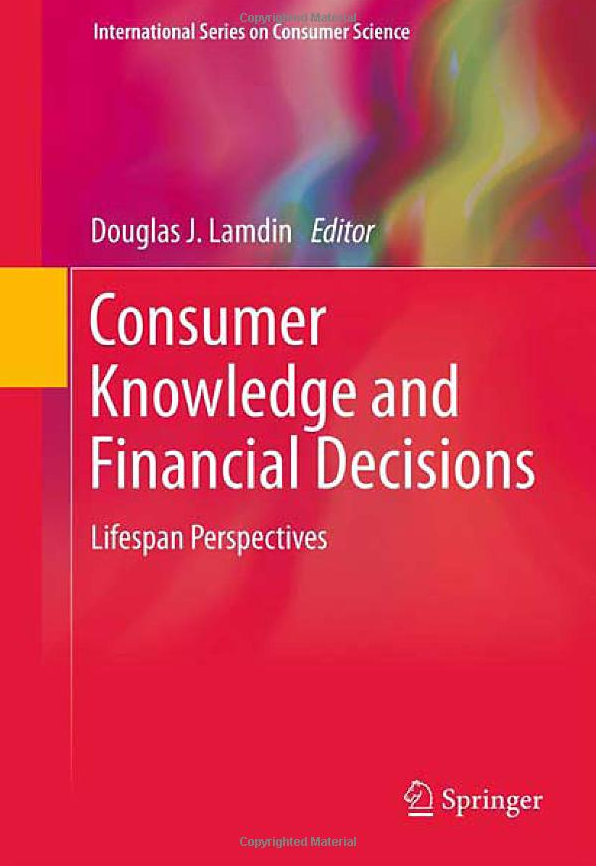
Douglas Lamdin, an economics professor at the University of Maryland Baltimore County, compiled an edited volume of research papers about financial education and behavior, “Consumer Knowledge and Financial Decisions.” The table of contents sorts issues by age groups, starting with “Cognitive Development and Children’s Understanding of Personal Finance” and ending with “Financial Preparedness for Long-Term care Needs in Old Age.” …Learn More

April 24, 2012
Marriage Negotiation: Of Chimp and Man
We human beings are close evolutionary cousins of the apes, closest of all to the chimpanzee and the bonobo. But economist Paul Seabright explains in his new book, “The War of the Sexes,” that male-female relationships differ from ape relationships. Squared Away asked Seabright to explain how evolution shapes financial negotiations between marriage or other partners. It all comes down to competition and cooperation, he says.
Q: Human behavior is determined by evolution?
Seabright: Yes. When Charles Darwin wrote “Origin of Species,” he was very, very cautious about saying too much about human behavior, because it was such a big thing to get people to swallow [that] we’d descended from animals. To talk about how human behavior was physically shaped, he didn’t do that until he wrote “The Descent of Man.” My book takes up the question of how much relations between men and women in modern society are shaped by our great ape inheritance.
Q: What is our evolutionary connection to the chimpanzee?
Seabright: The chimpanzee and the bonobo are like our two cousins. We share grandparents with them, a species that no longer exists, and all of us share great grandparents with gorillas. But we [humans] did this funny thing, which is we went into having kids who took much longer to raise. That’s relevant to financial behavior, because we have to look out for the future including the future of our kids, and there’s something especially human about that. Other species look after their kids, of course, but it’s a much bigger deal for us. …
Learn More
April 12, 2012
Fraud Against Elderly Documented
Chilling. That sums up a documentary about financial fraud against elderly people premiering tomorrow at the Quad Cinema on 13th Street in Manhattan.
“Last Will and Embezzlement” is about fraudsters who seek out vulnerable elderly people suffering from cognitive decline for no other purpose than to exploit their trust and steal their money. It’s not uncommon for these con men and women to be family.
By first-time producers Pamela Glasner and Deborah Louise Robinson, the film would’ve benefitted from more reporting and more focus – they try to do too much when they get into court systems and solutions. But the film does what journalism does best: It finds people willing to tell personal gripping stories – not easy to do – and gives them a voice.
- Mickey Rooney, 91, relived his searing emotional pain on screen, as he recounted how his own nephew “swindled” his money years ago.
- An elderly woman with Alzheimer’s was persuaded by a mortgage broker to take out a complex reverse mortgage, which resulted in foreclosure on her home and a legal battle waged by her children. “My mother was incapable of understanding any of this,” her daughter said. …
April 10, 2012
I’ll Save More – Just Not Today Please
We know that not enough Americans save for retirement. Behavioral finance professor Shlomo Benartzi devised a way to fix it – quite awhile ago, in fact.
To ease the pain of saving money, Benartzi and economist Richard Thaler designed a now-famous program in which employees can commit to increase their 401(k)s savings when they get a raise.
Saving is painful because it requires sacrifice, but committing to save money that one doesn’t yet have synchs with human psychology. In 1998, Benartzi and Thaler tested their theory on blue-collar workers in a Midwestern manufacturing plant, and it worked.
The key to saving, Benartzi said, is “embarrassingly simple but extremely powerful.”
The finding was nothing short of ginormous, though employer adoption has been modest. David Wray, president of the Plan Sponsor Council of America, estimated that about 10 percent of U.S. employees with 401(k) plans at work have automatic savings increases, typically at raise time. It’s much more common among mega-employers, he said.
If you’ve heard about behavioral economics but haven’t had time to learn what it’s really about, this 15-minute TED video in which Benartzi explains is an excellent start.

April 5, 2012
The Family That Dines Together…
New research adds a dash of spice to our understanding of how people handle their personal financial matters: families who dine together grow wealthy together.
Three professors at the University of Georgia have discovered that families who commit to gather regularly around the dinner table – or, presumably, dine out or cook together – are better prepared financially and will accumulate more wealth faster.
As with any statistical analysis, their research can’t prove cause and effect. Is it that dining together causes wealth to go up, or is that families who know how to handle their finances also tend to be the type of people who enjoy meals together?…Learn More
March 15, 2012
Fraudsters Hone Art of Disguise
Tried-and-true financial frauds – Ponzi schemes, high-yield investments, and “pump and dump” stock scams – have victimized unsuspecting targets for decades, even centuries.
These well-known frauds are effective, because con men change their disguises so they won’t be recognized. Six common disguises are detailed in a report I wrote for the Financial Security Project at Boston College’s Center for Retirement Research, which hosts this blog.
About Squared Away

Learn more about our blog and its writer, Kimberly Blanton, a former Boston Globe reporter.
