

Posts Tagged "retirement"

January 17, 2012
Target Date Funds Deciphered
This blog’s mission is to explain financial behavior – why we do what we do. It is not to provide personal financial advice about what to do. The mere mention of a “Target Date Fund” was a conversation stopper for me.
No longer. The Center for Retirement Research, which sponsors Squared Away, explains them simply and clearly in a new booklet. The name is inscrutable but the concept isn’t. In fact, your employer’s target date fund, if it is well designed, should make investing easier, not more difficult.
Check out the booklet, “Why Target Date Funds?”, (along with brochures about how to decide when to claim Social Security and how to manage your money after retirement).Learn More
January 10, 2012
Married Women Gain on Singles
 For decades, single women earned much more than married women over their working lives. But new research on historical wage trends finds that the earnings gap is finally closing.
Wages for married women without a college degree have increased faster over the past 50 years than wages for their single coworkers without degrees, making them nearly identical. While single women with a college degree still earn more than married women with a degree, the gap has also closed dramatically: Single women earned $1.12 for every dollar earned by married women in 2006, compared with $1.30 for single women who entered the workforce in the early 1960s.
Married women “have caught up tremendously,” said Chinhui Juhn, labor economist at the University of Houston, who conducted the research with Kristin McCue at the US Census Bureau for the National Bureau of Economic Research. …Learn More

January 5, 2012
The Mathematics of Longevity
Thanks to modern medicine, Americans’ longevity increased by 30 years during the 20th Century. During that time, the retirement age plunged, a byproduct primarily of a prosperous post-World War II economy.
An urgent need to squeeze more retirement money out of fewer years of work is now bearing down on the baby boom generation. But we haven’t adapted our lives or plans to fill in that yawning gap. Retirement today can last 20, even 30 years. The challenge of funding retirement is greatest for women, who earn less than men and live longer.
Steve Sass, my colleague at the Center for Retirement Research (CRR) at Boston College, encourages people to think about it this way and proposes a solution. For someone who works 40 years, retirement could last 20 years. That’s a 2-to-1 ratio of work-to-retirement years – with that ratio, it’s tough to make the financials work. It’s even harder if one’s retirement lifestyle will be based on those larger, late-career paychecks.
For those who have a job, consider what happens by adding five years of work. The work-to-retirement ratio is a “more manageable” 3-to-1, said Sass, who is co-author, with CRR Director Alicia Munnell, of “Working Longer: The Solution to the Retirement Income Challenge.”
That’s not all. Instead of retiring at age 62, an additional five years of work results in 44 percent more in your monthly Social Security check.Learn More

December 1, 2011
Card Minimums Cause Puzzling Behavior
What is it about the minimum payment on credit card statements that makes people act so crazy?
Two years ago, Neil Stewart, a psychologist at the University of Warwick in the United Kingdom, confirmed his own and some behavioral economists’ suspicions: when the minimum payment line was entirely deleted from statements, cardholders paid 70 percent more.
The holiday shopping season is in full swing, underscoring how important this initial finding was. Credit-card companies set their minimum payments extremely low, significantly increasing customers’ total payouts over the long term – paying the minimum causes interest costs to accumulate faster.
Stewart and his colleagues have now advanced his prior research by testing how card-carrying Americans and British would react to different levels of minimum payments. The result this time: the higher the minimum, the less people paid.
“We’re not entirely sure what’s going on in people’s heads,” said co-author Linda Salisbury, a professor in the Carroll School of Management at Boston College. The key, however, is a well-known psychological concept called “anchoring,” she said. …Learn More

November 29, 2011
401(k)s: Reaching Young Employees
Nearly one in three employees under age 35 has not enrolled in their 401(k) retirement plan, according to almost half of the major corporations surveyed recently by Northern Trust.
It’s “imperative” that young employees save more than they do, said Lee Freitag, senior product manager for defined contribution solutions at Northern Trust, which surveyed Altria Group, Microsoft, Walgreen and other U.S. companies.
Today’s young workers will rely more on 401(k) savings than any previous generation, he said, now that employer-funded pension plans are virtually extinct in corporate America. Yet many are sacrificing their prime savings years. To retire at age 70, for example, a 25-year-old must save only 7 percent of his or her income, earning investment income over 40 years. This compared with a steep 18 percent of income for someone who waits until age 45 to start saving and has fewer years to accrue investment returns.
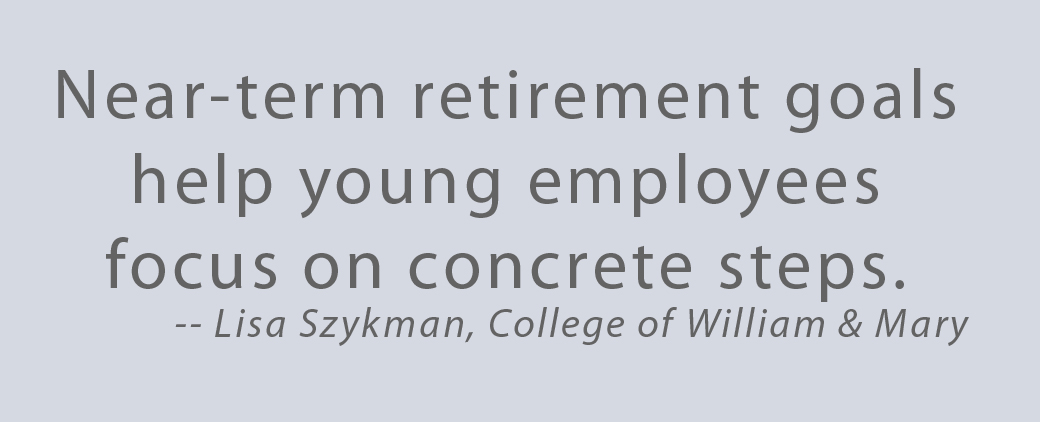 So, how to reach these young adults when it counts? To them, retirement in their 60s is an abstraction – they do not naturally focus on it. According to preliminary research out of the Mason School of Business at the College of William & Mary, how employers communicate may be the key to boosting savings among recent entrants to the workforce, given their long time horizon until retirement.
“We may need to communicate with younger workers differently than older workers,” Nicole Votolato Montgomery, Lisa Szykman, and Julie Agnew write in their new paper.
Their research indicates that employers can help younger employees define the steps they should take – by making them more concrete. This is a different twist on the psychology of saving found in other psychological research – when college students in one experiment saw computer avatars of their older selves, they wanted to save for their old age. …Learn More
November 16, 2011
Readers: Long-Term Care Policies Costly
One intention in introducing Squared Away this year was that it would become a forum for readers to share views about financial behavior, psychology, decision-making, products, education, and culture.
Some articles have been more successful than others in generating readers’ comments in the space provided at the end of each post. A post last week, “Long-Term Care: To Buy or Not to Buy,” was notable for the heat it generated.
It provided reasons the vast majority of the elderly do not purchase long-term care coverage from an insurance company. While the article, based on academic research, was about personal decision-making, readers focused on problems with the policies themselves:
Samantha Price noted:
Firstly, they are very expensive, so no one should be surprised why so many people are not buying. Secondly, many of the more affordable policies are issued by below-quality insurers, who have already shown their unreliability by being unable to pay their policyholders.
VG replied: …
Learn More

November 8, 2011
Long-Term Care: To Buy or Not to Buy
Let’s face it: thinking about long-term care insurance, nursing homes and home health aides is depressing.
It’s no wonder that just 10 percent to 12 percent of America’s elderly population has purchased a long-term care policy.
More are thinking about it though: New research shows that 40 percent of people 50 years or older who were surveyed had “thought a lot about needing long-term care” if they were to become ill in old age.
This research delved into the factors driving individual decisions about whether to buy long-term care coverage – or not buy. The decision “depend(s) on a complex amalgam of many different factors,” concluded a conference paper based on research conducted by the NBER Retirement Research Center.
Here are some of the findings in the paper, by Jeffrey Brown at the University of Illinois, Gopi Shah Goda at Stanford University, and Kathleen McGarry at the University of California at Los Angeles: …Learn More
About Squared Away

Learn more about our blog and its writer, Kimberly Blanton, a former Boston Globe reporter.
